|
Volume 18, Issue 16 - Friday, April 17, 2020
|
Texas cities, counties eligible to receive $11.24B from Coronavirus Relief Fund
 |
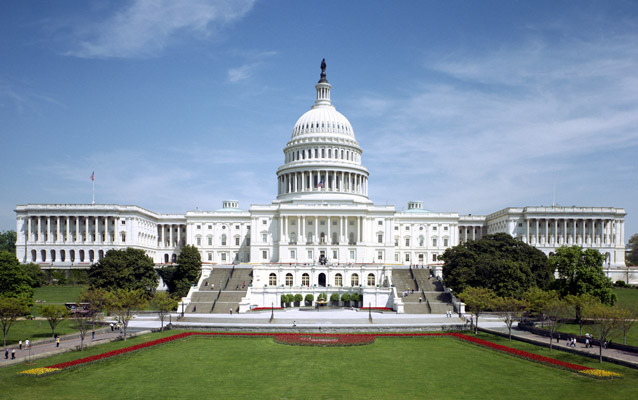
| | US Capitol |
More than $11.24 billion from the $150 billion Coronavirus Relief Fund is set to go to the state of Texas and several of its cities and counties, according to guidelines the U.S. Department of the Treasury published this week based on U.S. Census Bureau population data.
The Coronavirus Aid, Relief, and Economic Security (CARES) Act established the fund for states and also for governments with populations greater than 500,000 to cover expenses incurred due to the COVID-19 public health emergency.
These governments must not have included these expenses in budgets they approved as of March 27. The timeframe for incurred expenses is between March 1 and December 30.
Texas cities and counties eligible for funds are:
| ● Austin | ● El Paso County
| ● Houston
| ● Bexar County
| ● El Paso
| ● Montgomery County
| ● Collin County
| ● Fort Bend County
| ● San Antonio
| ● Dallas County
| ● Fort Worth
| ● Tarrant County
| ● Dallas
| ● Harris County
| ● Travis County
| ● Denton County
| ● Hidalgo County
| ● Williamson County
|
The amount of payments made to each state will be reduced by the aggregate amount of payments that will be disbursed to eligible local governments within that state that have provided the required certifications to Treasury.
Applications and certifications are due by 11:59 p.m. EST April 17 in order to receive funds within the 30-day period specified by the CARES Act.
|
Mayors seek coronavirus funds for small cities, flexibility in spending on relief
|
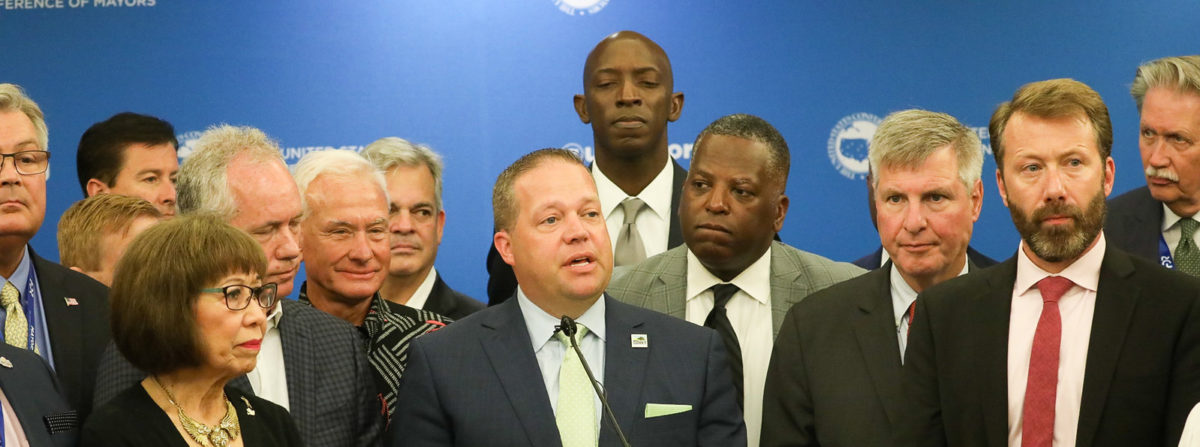
| | | US Conference of Mayors | |
More than 100 Texas mayors wrote to the state's Congressional delegation on April 15 seeking additional federal aid in response to the Coronavirus Relief Fund's population requirement that excluded cities with populations less than 500,000.
In their letter, which followed a similar April 13 letter from The United States Conference of Mayors to all members of Congress, the mayors sought passage of a fourth stimulus bill (HR 6467) introduced by Rep. Joe Neguse, D-Colo. The bill would appropriate $250 billion for direct fiscal assistance to local governments with populations below 500,000.
The mayors also encouraged the representatives to support a proposal to allocate $150 billion in funding to states and cities from the U.S. Housing and Urban Development (HUD) Community Development Block Grant (CDBG) program that provides grants to help cities, counties, and states recover from Presidentially declared disasters, especially in low-income areas.
Mayors from Texas' larger cities expressed gratitude that their cities would receive assistance from the Coronavirus Relief Fund, but they requested the fourth bill correct the relief fund to allow their cities more flexibility in how they use the monies.
Among the mayors who signed the letter were Dallas' Eric Johnson, Houston's Sylvester Turner, Austin's Steve Adler, San Antonio's Ron Nirenberg, Arlington's Jeff Williams, and Fort Worth's Betsy Price.
|
FAA to send $811.5M from CARES Act to airports for operations, revenue losses
|
|
Texas airports are set to receive more than $811.53 million from the Coronavirus Aid, Relief, and Economic Security (CARES) Act Airport Grant Program, the U.S. Department of Transportation (USDOT) announced on April 14.
USDOT's Federal Aviation Administration (FAA) will deliver about $10 billion in CARES Act grants in April to eligible commercial and general aviation airports around the country affected by the COVID-19 public health emergency.
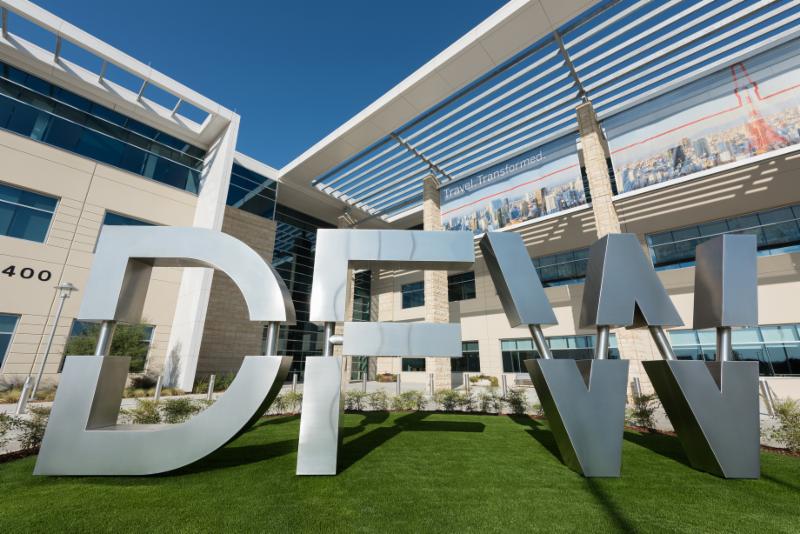
Dallas-Fort Worth International Airport is set to receive the largest award of $299.2 million among the 210 Texas airports eligible for funding, followed by George Bush Intercontinental at $149.19 million. Houston's other airport, William P. Hobby, will receive $50.87 million while Dallas Love Field will get $53.81 million.
Austin-Bergstrom International will collect $58.74 million, and San Antonio will get $39.71 million.
Midland International Air and Space Port will receive $22.94 million, Harlingen's Valley International Airport will get $20.45 million, Laredo International will accept $18.51 million, Waco Regional will get $18.09 million, and El Paso International will receive $15.43 million.
Airports will be able to use the funds to support continuing operations and replace lost revenue resulting from the decline in passenger traffic and other airport business due to the pandemic. The funds are available for airport capital expenditures, airport operating expenses including payroll and utilities, and airport debt payments.
The CARES Act also provides funds to increase the federal share to 100 percent for grants awarded under the fiscal year 2020 appropriations for Airport Improvement Program (AIP) and Supplemental Discretionary grants. Under normal circumstances, AIP grant recipients contribute a matching percentage of the project costs.
|
State to phase-in reopening of economy
|
| |
Texas Gov. Greg Abbott issued several executive orders on April 17 that will reopen the state's economy in several phases and enact additional measures to deter the spread of COVID-19.
Abbott's first order established a state economic strike force led by businessman James Huffines that includes Lt. Gov. Dan Patrick, Speaker of the House Dennis Bonnen, Attorney General Ken Paxton, and Comptroller Glenn Hegar. Mike Toomey, former chief of staff to governors Rick Perry and Bill Clements, will be its chief operating officer. The strike force also will include Texas health commissioner Dr. John Hellerstedt, Supply Chain Strike Force member Dr. John Zerwas, Dr. Parker Hudson of Dell Medical School, and other health care administrators and executives. Based on strike force recommendations, the reopening of businesses that pose minimal or no threat will occur in phases. The first phase will begin on April 24 with businesses allowed to reopen that offer "retail to go" pickup services and adhere to Department of Health and Human Services guidelines. No one from the public will be allowed to enter these locations. Abbott said revised plans will be announced - based on coronavirus results - that would allow for further expansion of the types businesses that may reopen such as restaurants and movie theaters. The plans will outline safe practices for employees and other regulations such as limitations on the number of customers allowed inside at one time and requirements they wear masks and practice safe social distancing. Additional April 17 executive orders established infection controls for nursing homes and assisted living centers, closed public, private, and higher education institutions in the state for the remainder of 2019-2020 school year, allowed the resumption of limited elective surgeries and diagnostic testing on April 22, and reopened state parks on April 20 with some restrictions. The governor said additional recommendations would be made on April 27 for comprehensive coronavirus testing, further expansion of non-emergency medical procedures, and expanded business regulations.
|

|
SAWS lets $180M Air Force sewer project
|
| | SAWS W-6 Upper Segment sewer project |
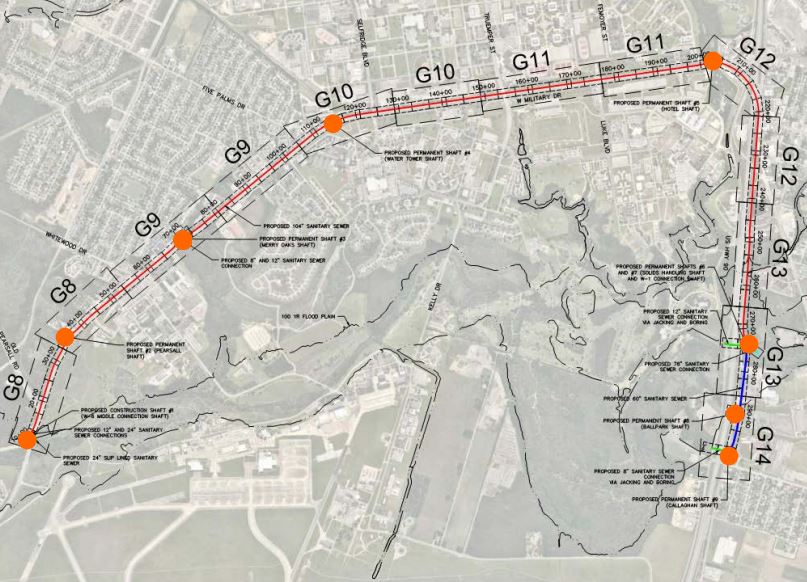
The San Antonio Water System (SAWS) is seeking competitive sealed proposals for the W-6 Upper Segment: Hwy 90 to SW Military Drive Sewer Main Project that will replace the existing sewer infrastructure that runs through Lackland Air Force Base.
Project scope calls for or the construction of about 29,000 linear feet of 60-inch, 78-inch, and 104-inch gravity sewer main via tunneling and short segments of open cut as well as construction of 16-foot diameter access shafts with depths from 40 feet to 145 feet deep.
New infrastructure will be built around the base and existing 48 and 54-inch gravity sewer mains will be abandoned.
Estimated project cost is $180 million. Proposals are due by 10 a.m. May 1.
SAWS anticipates awarding the contract and issuing a notice to proceed in July for the largest project in its Sanitary Sewer Overflow Reduction Program (SSORP).
|
Texas GDP percent gain outpaces others
|
| | | Houston industrial district | |
Texas' gross domestic product (GDP) led the country as the fastest-growing among the states in 2019, according to the U.S. Bureau of Economic Analysis.
Mining, quarrying, and oil and gas extraction contributed the most to Texas' 4.4 percent GDP growth among industries included in the bureau's analysis of 2019. However, Texas' oil and gas extraction as well as manufacturing started to slow in the fourth quarter.
Washington achieved the largest increase in real GDP during the same period that saw the country's real GDP rise by 2.3 percent.
Nationally, utilities increased 23.3 percent and contributed to growth in all 50 states and Washington, D.C.
Retail trade increased 7.4 percent and finance and insurance rose 5.1 percent to contribute to growth in every state and the District of Columbia. Government increased 2.7 percent nationally and contributed to growth in 49 states and the District of Columbia.
|
Baytown sets hotel-convention center budget of $63.6M for Bayland Island
|
| | Bayland Island |
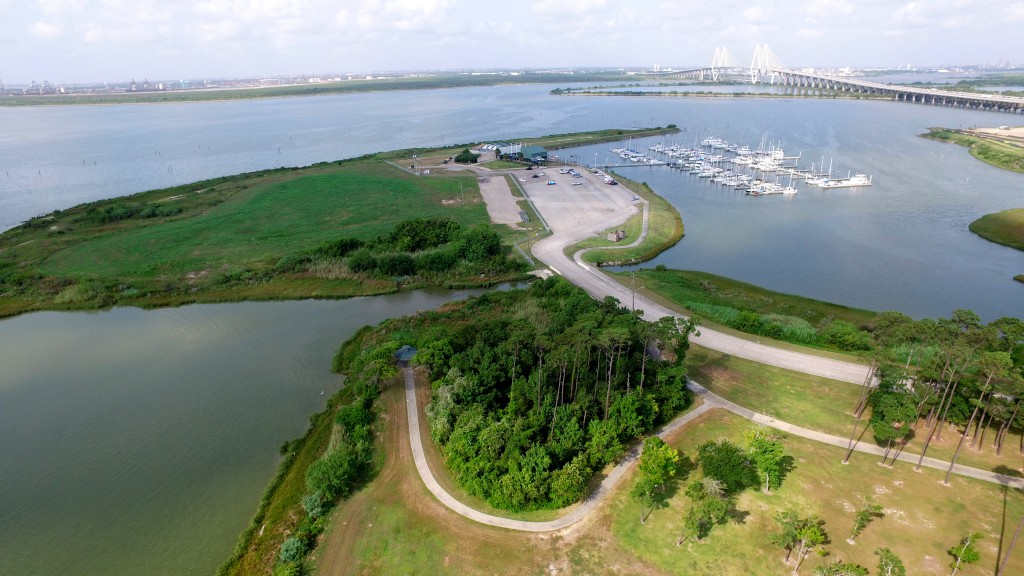
Members of the Baytown Hospitality Public Facilities Corporation approved a $63.6 million budget on April 9 for the Baytown Hotel-Convention Center Project on Bayland Island.
The conceptual development budget sets design-build hard costs at $27.63 million to construct a 208-key hotel and $14.3 million to build a 34,000-square-foot convention center.
City leaders said Baytown will contribute $21.1 million to the public-private partnership to finance construction of the convention center and private developers will put in $42.5 million for the hotel portion.
Baytown will issue bonds for $17.1 million and draw $4 million from the city's Hotel Occupancy Tax fund to pay for the convention center.
Construction is estimated to take 18 months.
|
UT Austin Health launches telehealth monitoring service to track COVID-19
|
| |
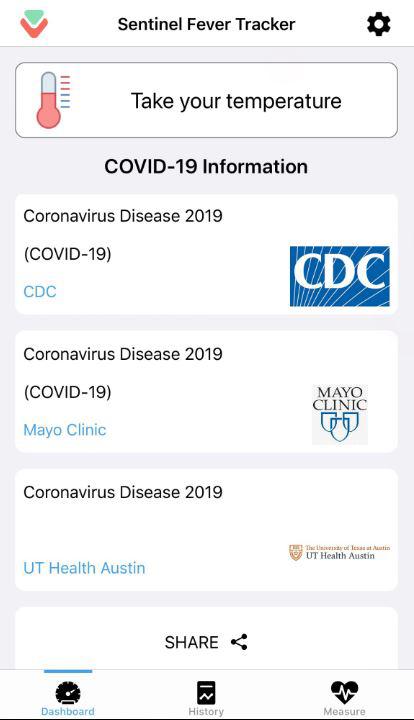
UT Austin Health recently debuted a new home health monitoring service to assist doctors and health care practitioners with treating patients through telehealth technology.
The new platform remotely tracks the health of people with COVID-19 using the company's technology platform originally designed to monitor blood pressure and oxygenation of stroke patients.
Platform capabilities will support health care systems, government agencies, and employers in monitoring, evaluating risk, and providing real-time alerts to providers when escalation of care is required for patients with COVID-19.
In the vast majority of cases, the physical impact of COVID-19 is "mild to moderate." But according to the Centers for Disease Control and Prevention (CDC), an estimated 21 percent to 31 percent of COVID-19 patients in the U.S. between February 12 and March 16 were hospitalized, with 5 percent to 12 percent being admitted to an intensive care unit.
Under the Home Health Monitoring program, people who have been exposed to the novel coronavirus may be provided with a digital thermometer that integrates into the platform. Users are prompted to answer questions about their symptoms and to record their temperature.
The program's algorithms then identify any rise in temperatures and worsening of symptoms that would require the attention of a medical professional. In that event, an alert is sent to the provider and the patient can be triaged for escalation of care, ranging from a call with their doctor for telehealth evaluation or a visit to the hospital.
In addition, a zero-touch, drive-through testing management system enables health care systems to track the results of patients tested for COVID-19 with the use of a scannable barcode.
|
Public Safety Office to distribute $38M for coronavirus prevention, preparation
The governor's Public Safety Office will provide $38 million to local governments from the Coronavirus Emergency Supplemental Funding Program for public safety use.
The $8.3 billion Emergency Appropriations for Coronavirus Health Response and Agency Operations Act signed into law in March established the program that is the source of these funds that local jurisdictions may use to prevent, prepare for, and respond to the coronavirus.
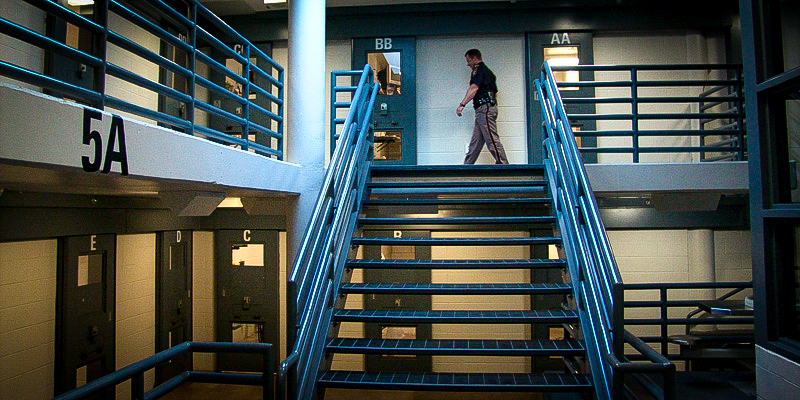
Examples of permitted projects and purchases include overtime, equipment such as personal protective equipment (PPE), supplies, training, travel expenses, and addressing medical needs of inmates in local jails and detention centers.
Any other costs associated with the implementation of the Centers for Disease Control and Prevention (CDC) COVID-19 Guidance documents are eligible.
The Governor's Public Safety Office is composed of the Criminal Justice Division, Homeland Security Grants Division, and Child Sex Trafficking Team.
|
Emergency Preparation Supplies Sales Tax Holiday scheduled for April 25-27
|
| |
The state of Texas will conduct an Emergency Preparation Supplies Sales Tax Holiday from April 25-27.
Texas Comptroller Glenn Hegar is asking Texans to shop online or follow strict social distancing measures for in-store shopping during the sales tax holiday that starts at 12:01 a.m. April 25 and ends at midnight April 27.
Shoppers may purchase certain emergency preparation supplies tax free during the sales tax holiday. No limit will be applied to the number of qualifying items that may be purchased. Exemption certificates are not required in order to claim the exemption.
These emergency preparation supplies qualify for tax exemption if purchased for a sales price:
- Less than $3,000 - portable generators;
- Less than $300 - emergency ladders and hurricane shutters;
- Less than $75 - axes and hatchets, batteries, nonelectric can openers, carbon monoxide detectors, nonelectric coolers and ice chests for food storage, fire extinguishers, first aid kits, fuel containers, ground anchor systems and tie-down kits, reusable and artificial ice products, portable self-powered light sources such as candles, flashlights, and lanterns, mobile telephone batteries and mobile telephone chargers, portable self-powered radios including battery-operated, two-way, and weather band radios, smoke detectors, and tarps and other plastic sheeting.
The sale of emergency preparation supplies purchased online or by telephone, mail, custom order, or any other method other than in person qualifies for sales tax exemption when either the item is both delivered to, and paid for, by the customer during the exemption period; or the customer orders and pays for the item and the retailer accepts the order during the exemption period for immediate shipment, even if delivery is made after the exemption period.
|
Rice University develops COVID-19 map
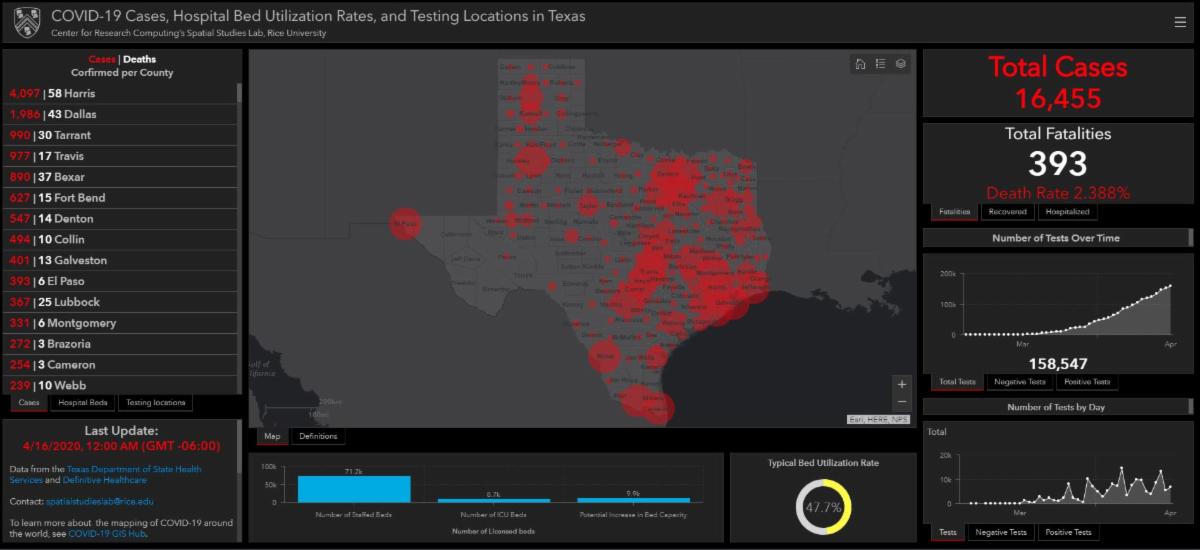
Rice University researchers have created an interactive map showing all cases of COVID-19 across Texas by using public health data from the Texas Department of State Health Services and a health care data provider.
The Center for Research Computing's Spatial Studies Lab developed the map that updates automatically on a daily basis at www.coronavirusintexas.org. It includes cases by county as well as the number of people tested across the state, current hospital bed use rate, and the numbers of staffed beds and intensive care beds in Texas hospitals.
Project leaders said the team is working on another layer to add to the map to show the number of available nurses. They also created interactive maps of COVID-19 cases in Brazil and Lebanon.
|
Comptroller reports phishing email
A Texas vendor reported a phishing email received April 13 claiming to come from the Texas Comptroller of Public Accounts. The message had the subject "The State of Texas Contract RFQ 2020" and asked the recipient to click on a link to review a purchase order. This email did not originate from the Comptroller's office, and agency officials believe it is an attempt to steal login credentials, products, or personal and financial information fraudulently from the vendor.
Additional information may be found on the Comptroller's Fraud Alert page.
|
|
Check out our social media links!
|
|
|
By Mary Scott Nabers, CEO of Strategic Partnerships, Inc.
Today we break our longstanding rule of never running a column twice. We do it only because this topic will impact all our readers in the coming months and years. This column first appeared in the April 15, 2020 edition of Government Contracting Pipeline.
The world as we know it has changed rapidly and dramatically in the last few months. Normalcy is but a memory at this moment in time.
People are losing their jobs, businesses are closing, people are struggling, and some are dying. This is truly a sad time in history because of COVID-19. But, better days are ahead, and we will survive. I'm convinced that it is important though to take note of what's ahead. Our future world will be filled with significant changes.
We have entered into a new industrial revolution. That is evident. Our lives and our businesses are destined to be forever more technology-oriented than we may be anticipating. In the near future, we will do business in different ways.
COVID-19 is ushering in a new industrial revolution that will revolve around the merging of technology, science, research and health care. The role of health technology overall will be a permanent change. Additionally, the partnering of health-related research, science, and technology has unleashed more creativity and innovation than world leaders could have ever envisioned only a few months ago.
It is astounding to consider some of the innovation that has occurred and a little overwhelming to ponder how it will impact our lives and our work. Health tech, or digital health, which involves the use of databases, applications, mobile apps, wearables and more to improve delivery, payments and services will spill over into all other types of other services and deliverables.
Artificial intelligence (AI) that scans millions of health records in minutes, 3-D printing of health equipment, hands-free door opening devices for individuals, big data analysis, wrist mounted disinfectant sprays, snood masks with antiviral coating, drones that disinfect large air spaces or carry sensors with thermal testing capabilities - these are but a few of the new innovations that will impact our future.
click here for more
|
Dallas mayor taps Fisher to lead task force on recovery
|
| | Richard Fisher |
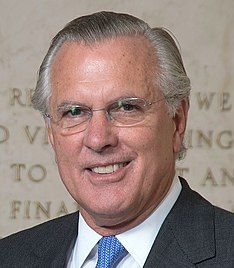
Dallas Mayor Eric Johnson formed the Mayor's Task Force on COVID-19 Economic Recovery and named Richard W. Fisher as its chairman on April 9.
Fisher is a senior financial advisor and is a director on the boards of technology, beverage, and health care companies.
He previously served as president of the Federal Reserve Bank of Dallas from 2005-2015 and deputy U.S. trade representative with the rank of U.S. ambassador.
Johnson created two ad hoc City Council committees to focus on local government policies in response to COVID-19's spread, but the Task Force will explore solutions beyond the scope of the city government.
In addition to Johnson, Deputy Mayor Pro Tem Adam McGough and Councilmember Casey Thomas will serve as the city's inaugural representatives on the Task Force.
|
Edinburg taps EDC interim director
|
| | Ron Garza |
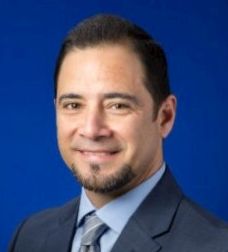
The Edinburg Economic Development Corporation (EDC) board appointed City Manager Ron Garza as its interim executive director. He succeeds Richard Hinojosa who also served as interim city manager and interim EDC director simultaneously.
Garza previously served as executive director of the Lower Rio Grande Valley Development Council.
|
Pflugerville names Collins IT director
|
| | Cody Collins |
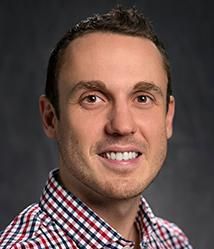
The city of Pflugerville announced Cody Collins as its new information technology (IT) director on April 15.
Collins previously served as a network analyst and IT manager at Louisiana State University where he oversaw the expansion and management of the university's network.
|
New Braunfels selects director of communications
|
| | Jenna Vinson |
The city of New Braunfels selected Jenna Vinson as its first director of communications and community engagement.
Vinson most recently served as the vice president of advocacy and outreach for the Greater New Braunfels Chamber of Commerce.
|
Murphy appoints Callaway as new municipal judge
|
| | Cass Callaway |
The city of Murphy appointed Cass Callaway as its municipal court judge on April 7.
Callaway opened a criminal defense law practice in 2006 after serving as the assistant city attorney for the city of Fort Worth.
According to his firm's website, Callaway also is the city attorney for Godley and Venus, Texas, and the appointed city prosecuting attorney for Blue Mound Texas. He practices in Tarrant, Dallas, Johnson, Hood, and Parker counties in county, district, and municipal courts.
|
Texas Tech center taps Sechrist health professions dean
|
| | Dawndra Sechrist |
Texas Tech University Health Sciences Center (TTUHSC) named Dawndra Sechrist as the new dean of the School of Health Professions. She succeeds TTUHSC interim president Lori Rice-Spearman who served as dean from 2016-2019. Steven Sawyer who served as interim dean the past eight months.
Sechrist is the associate dean for outcomes and assessment at the TTUHSC School of Health Professions and a tenured associate professor. She previously was the director of the Master of Occupational Therapy program at TTUHSC. Sechrist joined the center in 2001 as an assistant professor.
|

|
Gov. Greg Abbott has announced these appointments/reappointments from April 10-16:
Pediatric Acute-Onset Neuropsychiatric Syndrome Advisory Council - Kara Chasteen of Bertram
- Anne Esquivel of New Braunfels
- Dan Freeland of Lakeway
- Lisa Formby of Hereford
- Sarah Garrett of Spicewood
- Suzanne Gazda of San Antonio
- Lisa Hardy of Argyle
- Anthony Infante of San Antonio
- Qazi Javed of Austin
- Paula Kruppstadt of The Woodlands
- Sharon Lemons of Saginaw
- Darcy McMaughan of College Station
- Amy Offutt of Marble Falls
- Carol Trautman of Austin
Texas Board of Professional Geoscientists
- Margon Dillard of Richmond
Board of Pilot Commissioners for Galveston County Ports
- Arden Hill III of Friendswood (reappointed)
- Kelly Lovell of Friendswood (reappointed)
Angelina and Neches River Authority Board of Directors
- Jody Anderson of Lufkin (reappointed)
- Thomas Murphy of Crockett (reappointed)
- Kimberly McRae Childs of Nacogdoches
Governor's Committee on People with Disabilities- Eric Lindsay of San Antonio
- Elyse Lieberman of Liberty Hill
- Kristie Orr of College Station
- Kori Allen of Plano
- Ellen Bauman of Joshua (reappointed)
- Archer Hadley of Austin (reappointed)
- Dylan Rafaty of Plano (reappointed)
- Aaron Bangor of Austin (reappointed)
- Evelyn Cano of Pharr (reappointed)
- Richard Martinez of San Antonio (reappointed)
- Emma Rudkin of Boerne (reappointed)
- Amy Scott of Austin (reappointed)
|
Federal Reserve Bank of Dallas - Eleventh District Beige Book
Office of Inspector General - Pandemic Response Oversight Plan
|
Dozens of public-sector jobs are available. Click here to view all job openings and guidelines for job submissions to SPI. New jobs added this week:
- City of Houston - City Secretary
- City of Dallas - Fire Protection Engineer
- City of Austin - Community Engagement Specialist
- City of Austin - Client Relationship Coordinator
|
View our Texas Government Insider and Government Contracting Pipeline newsletter archives
|
Help us share this message.
To ensure delivery and proper formatting of the newsletter, be sure to add editor@spartnerships.com to your safe senders list. Otherwise, the newsletter may be flagged as spam and automatically routed to your junk e-mail folder.
|
Texas Government Insider is a free weekly newsletter detailing important happenings throughout the state and summarizing current political issues relevant to individuals interested in government.
Publisher: Mary Scott Nabers
Editor: Devin Monk
TGI is published by Strategic Partnerships, Inc. (SPI), a research and consulting firm. Founded in Texas in 1995 by former government executives and public sector experts, the SPI Team has developed a national reputation for partnering public and private sector entities.
To learn more about SPI services, click here or contact our sales department at 512-531-3900.
Barton Oaks Plaza One, Suite #100
901 S. Mopac Expressway Austin, Texas 78746
|
|
 |
|