Volume 18, Issue 17 - Friday, April 24, 2020
|
Governor: Texas to reopen in stages
Gov. Greg Abbott confirmed in a private conference call with lawmakers on April 23 that he will issue an executive order on April 27 that details how the state will reopen businesses in stages and by county based on several local coronavirus indicators.
Abbott said the reopening would begin in early May after the expiration of his stay-at-home order on April 30 and supersede local orders.
Using doctor-approved guidelines, some businesses will be allowed to partially reopen depending on growth rate of confirmed cases, death rate, and hospitalization totals in each county.
He specifically mentioned hair salons, restaurants, and movie theaters as some of the businesses that could reopen in May as long as they follow distancing guidelines. Sporting events could be conducted without spectators present, and public beaches could open this summer.
In counties where risk of infection is higher, the extent of reopening would be very limited or completely prohibited until the virus' growth rate decreases.
The governor said state leaders understand that expansion of the coronavirus has occurred in countries that have reopened their economies, but he said Texas could accept that here, given that the expansion is minimized.
He said he is looking ahead to 2021 and beyond as a guide to reopening the state's businesses in stages to avoid a possible resurgence of the coronavirus and closing businesses again.
|
Congress passes $484B relief bill to boost SBA loan program, hospitals
|
|  | | Treasury Department | |
The U.S. House of Representatives passed a $484 billion pandemic relief bill on April 23 to join the U.S. Senate, which approved it two days earlier.
The Paycheck Protection Program and Health Care Enhancement Act will inject $310 billion in loans into the depleted Small Business Administration's (SBA) Paycheck Protection Program (PPP) created by the stimulus bill in March.
After the PPP exhausted its initial $350 billion allocation last week, complaints arose that larger businesses or those with strong relationships to their banks received the majority of the funds over smaller companies.
The new act allocates $60 billion in PPP loans for medium, small, and community lenders and another $60 billion to the Economic Injury Disaster Loans program that offers loans up to $2 million.
It also appropriates $75 billion to hospitals and health care providers and $25 billion to boost testing efforts nationwide. It does not include funding for state and local governments.
President Trump signed the bill on April 24.
|
GLO prepares takeover of Houston's Hurricane Harvey federal assistance
The Texas General Land Office (GLO) notified the city of Houston on April 22 that it will seek approval to cancel nearly $1 billion in federal Hurricane Harvey housing recovery funds to the city and take over administration of the program.
GLO Commissioner George P. Bush wrote Houston Mayor Sylvester Turner that due to ongoing concerns about the city's administration of Community Development Block Grant - Disaster Recovery (CDBG-DR) programs, the land office would draft an amendment to the state's action plan. Upon approval by the U.S. Department of Housing and Urban Development (HUD), the amendment would eliminate all funding to the city and transfer all responsibility for administering disaster assistance to city residents to the GLO.
Bush wrote that the city rejected GLO's efforts to help it meet performance goals and to renegotiate the contract between the two parties to allow for more timely disbursements of allocated funding. Four years remain in the six-year period in which the CDBG-DR grant must be used.
A week prior to his letter to Turner, the Texas General Land Office Community Development and Revitalization division (GLO-CDR) wrote Turner noting a lack of timely expenditures in a March 17 performance review but also stating appreciation for the city's response to resolve the outstanding item and finding its March 31 status report addressed the GLO's findings.
According to the situation report, the GLO had approved 181 applicants for eligibility as of March 31. Of those, 59 homeowners have received notices to proceed on construction and 44 received reimbursement checks.
Turner said in response to Bush's letter that the GLO did not provide written instructions for documents necessary to approve home applications, made several process changes, and required the city to resubmit hundreds of files. He also noted that the GLO would not fund three-bedroom homes.
Bush offered a compromise to Turner - within a week of receipt of the letter, the city could agree with the GLO to mutually terminate the contract in full and negotiate the possible retention by the city of its Multifamily Rental Program, Homebuyer Assistance Program, Public Services, and Planning activities under a new subrecipient agreement. This option would enable the city to continue as an administrator of critical recovery efforts that are showing progress.
|
Texas education institutions eligible for $1.28B from new CARES tranche
|
| | | The University of Texas at Austin | |
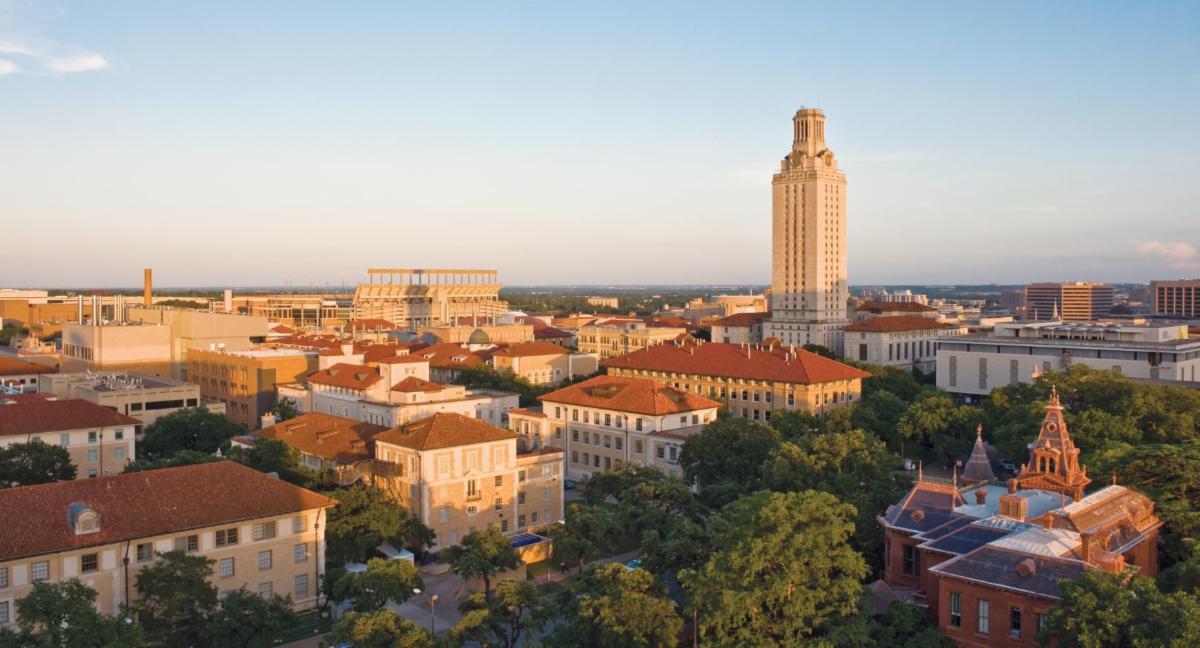
Texas' state and local education institutions will be eligible to apply for more than $1.28 billion from a $13 billion tranche of federal CARES Act funding announced on April 23.
The U.S. Department of Education will disperse aid from the Elementary and Secondary School Education Relief Fund (ESSER).
Funding allocations are part of the nearly $31 billion Congress allocated to the department to distribute to students, K-12 schools, and higher education institutions.
The department also developed a process for providing states with funding flexibilities so that they can repurpose existing K-12 education funds for technology infrastructure and teacher training on remote learning and to move resources to areas of highest need.
To determine the ESSER Fund allocations, the department used the fiscal year 2019 state shares of Title I, Part A allocations for low-income families without the application of the hold harmless provisions.
Local leaders will have the flexibility to determine how to use their ESSER funds, as long as they comply with applicable federal education laws. State Education Agencies (SEAs) must allocate 90 percent of their ESSER funds to local education agencies, including public charter schools. Up to 10 percent of the SEA's award may be retained for the state agency to use to address needs related to responding to coronavirus.
After one year, SEAs must return any funds that have not been awarded, and the U.S. secretary of education will reallocate those funds to the states.
|
State transportation commission set to vote on $491.7M I-35E solicitation
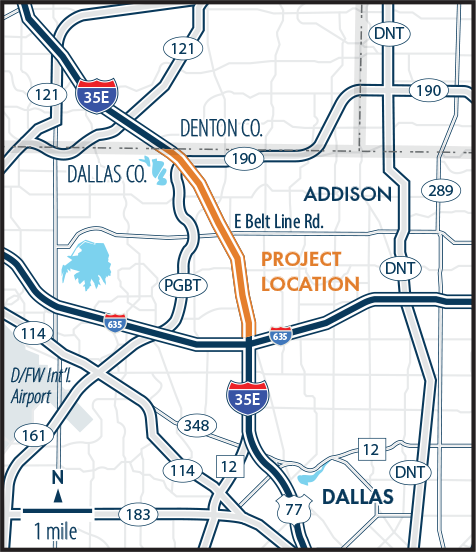
The Texas Transportation Commission is set to vote on authorization of a request for qualifications (RFQ) at its April 30 meeting for the Interstate 35E Phase 2 reconstruction and widening project in Dallas County.
Construction costs for the Texas Department of Transportation (TxDOT) design-build expansion project are estimated at $491.7 million, and design costs are projected to be $78.3 million.
TxDOT will widen I-35E's general purpose lanes from six to eight lanes, reconstruct its two existing toll managed lanes, add continuous frontage roads, and make several intersection improvements along a 6.39-mile segment from Interstate 635 past the President George Bush Turnpike to the Denton County line. No new toll lanes will be built as part of this project.
Estimated construction start is late 2021 with completion set for 2026. The project will benefit from a $230 million Texas Clear Lanes contribution.
|
Corpus Christi to seek water board assistance with desalination plant
|
| | | Seawater desalination plan illustration | |
The Corpus Christi City Council authorized staff to apply for $222.48 million in financial assistance from the Texas Water Development Board (TWDB) for the construction of a seawater desalination plant.
TWDB officials included the city's desalination plant project in the 2020 State Water Implementation Fund for Texas (SWIFT).
The water board also invited Corpus Christi and other municipalities to submit full applications by May 11. Abridged applications were due February 3.
If approved, the city would apply the TWDB funds to the procurement, design, and construction costs for its proposed seawater desalination plant on the Inner Harbor Ship Channel.
Corpus Christi also has submitted permits to the Texas Commission on Environmental Quality (TCEQ) for water discharge permits and water rights on the Inner Harbor Ship Channel and a possible future plant on the La Quinta Channel.
TCEQ is taking public comments on the permit application. The discharge permit on the application for the Inner Harbor facility is expected to be declared administratively complete in the near future. Both sites would produce public drinking water for the region.
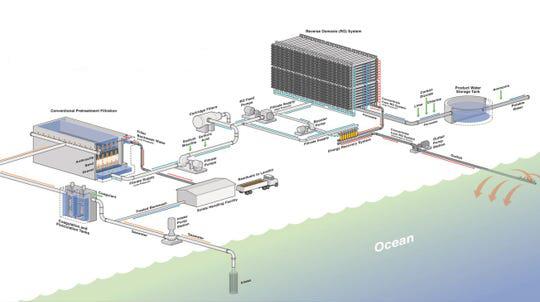
The envisioned plants will use reverse osmosis technology with diffusers at the outfall. Intake of source water and outfall of concentrate will be from the two channels. Dewatered residual solids will be disposed at the city's regional landfill. The plants would be designed to allow for future expansion with environmental and operational factors considered in terms of the ultimate size.
Production capacity at the Inner Harbor Desalination Plant would be an initial 10 million gallons per day (MGD) that would increase to 20 MGD with expansions to reach 30 MGD ultimately.
The La Quinta plant would begin operations at 20M GD and increase production capacity to 30 MGD through expansion and 40 MGD in ultimate capacity.
|
Some leaders tout infrastructure investment as economic stimulus
Several Texas leaders are advocating investments in transportation infrastructure to help stimulate the economy.
Work continues in both the public and private sector on high-speed and light rail projects such as Trinity Metro's TEXRail commuter line extension, and plans for multi-billion dollar highway improvements in Dallas and Austin are moving forward.
Citing successful transportation projects delivered during the 2008-09 recession, the director of the North Central Texas Council of Governments (NCTCOG) said these current projects are vital to reemploying thousands of Texans.
NCTCOG is one of several transportation authorities around the country vying to be the site of a hyperloop test track that uses a pneumatic tube to propel passenger and freight cars at speeds up to 670 mph. The council also is reviewing several highway reconstruction projects in the Dallas-Fort Worth Metroplex.
A lack of traditional funding could be offset by implementing new technology and forging public-private partnerships in order to see the projects through to completion.
|
CAMPO delays 2045 project list vote
|
| | | Map of CAMPO 2045 Draft Regional Projects | |
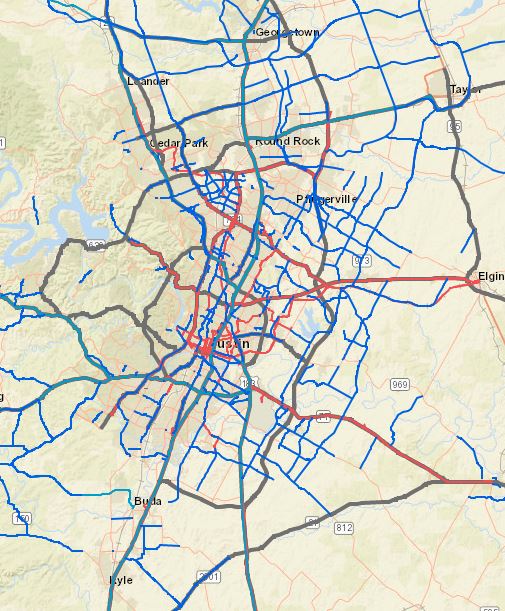
The Capital Area Metropolitan Planning Organization (CAMPO) adopted a resolution on April 20 to commit an allocation of $633 million to help fund the Interstate 35 Capital Express project in Austin after weeks of discussion and public input.
When CAMPO first agreed to the financial assistance, its Transportation Policy Board understood that it would have to cut several projects from its draft 2045 Regional Transportation Plan in order to free up those funds.
Amid criticism that CAMPO's decision would be made in haste, the organization extended the public comment period to allow for more input and analysis before finalizing the list of projects in the long-range plan.
The 2045 plan will address transportation needs over the next 25 years in CAMPO's service area of Bastrop, Burnet, Caldwell, Hays, Travis, and Williamson counties. This multimodal plan includes a variety of transportation modes including driving, walking, biking, transit, and emerging technologies.
CAMPO staff will be evaluating and scoring projects that are eligible for Category 7 funding via the Federal Highway Administration's Surface Transportation Block Grant program based on readiness for construction and other criteria.
The Transportation Policy Board is set to review staff's project rankings at its June 8 meeting.
|
 |
|
Allen ISD committee forming project recommendations for possible bond
|
| | Allen ISD security center |
An Allen ISD (AISD) citizen bond advisory committee is scheduled to present its recommendations for capital improvement projects to the district's board of trustees in June for a bond election possibly in November.
The Project Kids committee has been meeting virtually since March 17. It is scheduled to hold seven meetings by June 22. Under a tentative schedule, trustees would conduct a special meeting on August 10 to consider calling a bond election before the August 17 deadline to place propositions on the November 2020 ballot.
AISD's previous bond election, which failed in May 2019, requested $422.8 million in funding authorization for school and athletic facility renovations, technology improvements, security enhancements, and new buses.
|
Runway extension, development drive Huntsville airport master plan update
|
| | | Bruce Brothers Huntsville Regional Airport | |
Huntsville City Council debated but ultimately approved a master plan for Bruce Brothers Huntsville Regional Airport on April 21 that includes a proposed $25 million runway extension from 5,005 feet to 5,500 feet.
The Texas Department of Transportation (TxDOT) is expected to contribute 90 percent of the funding for the runway extension designed to serve current and future needs of critical aircraft.
Some councilmembers said the extension should be longer, but city officials said that Huntsville could proceed with the project at the regional airport and build another runway at a different location.
The centerpiece of the master plan is the completion of the airport layout plan (ALP) that will be updated during the latter stages of the master plan. The ALP will illustrate existing and ultimate airfield and terminal area facilities and proposed layouts, property interests, land use, and airspace improvements.
Other master plan objectives are to expand the airport's main apron and terminal area and conduct a site assessment of the potential development area on city-owned land west of the runway.
Additional goals are to identify phased airfield expansion options to meet demand, design capabilities for accommodating categories of larger aircraft, assess aeronautical uses at Huntsville, and determine the airport's role among general aviation airports north and west of Houston.
|
Austin extends solicitation deadline for Zilker Park master plan RFQ
|
| | Zilker Metropolitan Park |
The city of Austin Parks and Recreation Department (PARD) extended its request for qualifications (RFQ) application deadline to April 30 for a firm to develop a master plan for Zilker Metropolitan Park.
Austin leaders desire a visionary framework to shape the restoration and future development of the 350-acre park that includes 77 acres of the Zilker Nature Preserve.
RFQ documents state the master plan should include recommendations for enhancement or development of facilities and programs, adequate distribution of restrooms and picnic facilities, and anticipated infrastructure and utility upgrades to the park. Development of a new Visitor Education Center has been previously recommended in a feasibility study and should be considered as part of the master plan process.
Other desired outcomes of the master planning process are to establish design standards that guide the future development of the park, focus on ecological and environmental features, recommend design of amenities accessible to all people, create a wayfinding and signage system, develop a transportation, circulation, and parking plan, and draft a business and management plan.
|
Tomball EDC acquires industrial park property with vision for mixed-use
The Tomball Economic Development Corporation (TEDC) announced the acquisition of 6.2 acres of South Live Oak Industrial Park earlier this month with the vision of creating a mixed-use development on vacant property.
TEDC's purchase includes two industrial warehouses totaling 41,076 square feet directly off Main Street near downtown Tomball. TEDC's executive director said the corporation will begin searching for a tenant for one of the warehouses.
The North Freeway/Tomball Parkway submarket, located between Highway 249 and Interstate 45 North, encompasses 30 million square feet of industrial and flex space. The submarket, which is 86.2 percent occupied, is the second largest of the four submarkets located in Houston's north industrial corridor. Annual absorption has increased by 35.7 percent, and close to 1 million square feet is under construction in the North Freeway/Tomball Parkway submarket.
|
|
Check out our social media links!
|
|
|
By Mary Scott Nabers, CEO of Strategic Partnerships, Inc.
Will students go back to public school campuses this fall?
Will charter schools reopen?
Will colleges and universities bring students back on campus?
Will testing be available?
Will facemasks be required?
How and when will educators spend the federal recovery funding that has been allocated?
Will projects with previously approved funding be launched soon?
These are the types of questions being asked throughout the country. Every question calls for difficult decisions. Education has been impacted in a huge way by COVID-19.
Governors and mayors will decide how and when to reopen schools. Education officials will determine when to launch new projects. Governors will direct large amounts of funding to school districts. But, those decisions will require difficult choices. No decision maker is clairvoyant, and as long as the country remains in uncharted territory in historically uncertain times, decisions made are likely to be diverse throughout America.
But, those difficult decisions must be made soon. Presently, almost everything is on hold. That cannot continue because plans and preparations must be made for what happens next.
Purchasing and contracting will continue at a fast pace at every level of education. Every state and region has projects to launch, and reopening educational facilities will require all types of purchases. The work of educating students will proceed.
|
|
SPI adds health care veteran to consulting team
|
| | Terri Sabella |
Strategic Partnerships, Inc. (SPI) is pleased to announce that Terri Sabella will bring her expertise in health care delivery and regulations to the SPI Team as a new external consultant.
As the chief executive officer of the Tennessee Primary Care Association, Terri provides collaborative leadership, advocacy, and support as the voice of the state's community health centers.
Prior to that role, Terri led a large multi-site, multi-specialty Federally Qualified Health Center (FQHC) in Texas first as its attorney and then chief operating officer (COO) and chief nursing officer. During her tenure as COO, the center doubled in size by adding sites and service lines while transforming its care delivery methodology to achieve Level 3 Personal Care and Home Management (PCHM) recognition.
Beginning her career in health care as an intensive care unit and trauma nurse, she developed an ethos for providing the highest quality of care without regard for the patient's ability to pay. That advocacy inspired her transition to law and graduation from Southern Methodist University's Dedman School of Law. As an attorney she has represented health systems, hospitals, physicians, and other practitioners.
Terri's background supplies her with extensive knowledge of health care delivery and a keen understanding of the legal and regulatory framework in which organizations must function combined with an unquestioned passion to serve.
|
El Paso taps Smyth to lead Sun Metro
|
| | Ellen Smyth |
The city of El Paso selected Ellen Smyth as managing director of Sun Metro.
Smyth currently serves as the city's director of environmental services, a role that she will maintain in her new position.
She previously worked as chief administrator for the county of El Paso, led the South Central Solid Waste Authority for the city of Las Cruces and Dona County, and served as a senior environmental engineer for a private company.
|
Petersburg names new city manager
|
| | Mario Martinez |
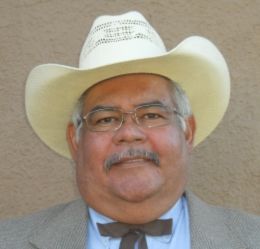
The city of Petersburg agreed to a two-year contract with Mario Martinez to be its new city manager on April 14.
Martinez is the Hale County Commissioner for Precinct 2. He will continue in that role during his tenure with the city.
|
Houston selects Murray to direct business office
|
| | Marsha Murray |
Houston City Council approved the appointment of Marsha Murray as the city's director of the Office of Business Opportunity on April 22. Murray has served as interim director since September 2019.
Murray previously served as the office's deputy director from 2012-2019. Prior to joining the city of Houston, Murray served as legal counsel to New York City government for 10 years.
|
A&M hires Griffin as IT director for student affairs
|
| | Darvis Griffin |
Texas A&M University named Darvis Griffin as director of information technology (IT) for the Division of Student Affairs and assistant chief information officer for the university on April 20.
Prior to joining Texas A&M, Griffin served as assistant superintendent and chief technology officer at Waco Independent School District.
He previously taught high school technology courses and held various IT positions in higher education, including Collin Community College, Texas A&M Health Science Center, and The University of Texas at Austin. He also has worked as a consultant for businesses and state agencies, including the Texas Education Agency.
|
Iraan-Sheffield ISD names lone finalist for superintendent
|
| | Dr. Tracy Canter |
The Iraan-Sheffield ISD board of trustees on April 22 named Dr. Tracy Canter as the lone finalist to be the district's next superintendent of schools. If approved by the board, she will replace Dr. Michael Meek who will end his term at the close of the school year.
Canter currently is serving as the executive director of special services for Ector County ISD.
|
Angleton names Whittaker as city's interim manager
|
| | Chris Whittaker |
The city of Angleton recently selected Chris Whittaker to serve as interim city manager. He takes over for Scott Albert who resigned in February.
Whittaker previously served as city manager for the city of Rockdale, Texas, and as a director of logistics and an industrial base maintenance team director in the U.S. Army.
|
A&M AgriLife offers CARES Act online training
The Texas A&M AgriLife Extension Service launched a series of free online training sessions to educate local officials how to acquire and administer federal assistance through recently passed aid packages.
On April 23, the AgriLife Extension began offering the training to help local leaders navigate the Stafford Disaster Relief and Emergency Assistance Act and Coronavirus Aid, Relief, and Economic Security (CARES) Act.
The first online training, "Federal Relief: An overview for local governments," is available now. Additional trainings will focus on individual programs based on the needs of state and local officials. Extension agents will be available to assist local leaders with questions throughout the training and federal funding application process.
The CARES Act authorizes approximately $2 trillion in federal stimulus funds to combat the crisis and stabilize the economy, including $150 billion available directly to states, territories, and tribal governments.
|
Gov. Greg Abbott has announced these appointments from April 17-23:
Albert Pattillo III - Kerrville, 216th Judicial District Court
Tomeka Moses Herod - Allen, Texas Medical Board
Jeannette Pierro Smith - Mission, Texas State Board of Public Accountancy
|
Texas A&M University - Real Estate Center - Monthly Review of the Texas Economy
Texas A&M University - Real Estate Center - Outlook for the Texas Economy
U.S. Bureau of Labor Statistics - Monthly Labor Review
|
Dozens of public-sector jobs are available. Click here to view all job openings and guidelines for job submissions to SPI. New jobs added this week:
- City of Houston - Senior Project Leader (Engineering Department)
|
View our Texas Government Insider and Government Contracting Pipeline newsletter archives
|
Help us share this message.
To ensure delivery and proper formatting of the newsletter, be sure to add editor@spartnerships.com to your safe senders list. Otherwise, the newsletter may be flagged as spam and automatically routed to your junk e-mail folder.
|
Texas Government Insider is a free weekly newsletter detailing important happenings throughout the state and summarizing current political issues relevant to individuals interested in government.
Publisher: Mary Scott Nabers
Editor: Devin Monk
TGI is published by Strategic Partnerships, Inc. (SPI), a research and consulting firm. Founded in Texas in 1995 by former government executives and public sector experts, SPI has developed a national reputation as the premier marketing partner dedicated to helping companies secure contracts in the $1.5 trillion state and local government marketplace.
To learn more about SPI services, click here or contact our sales department at 512-531-3900.
Barton Oaks Plaza One, Suite #100
901 S. Mopac Expressway Austin, Texas 78746
|
|
|
|