
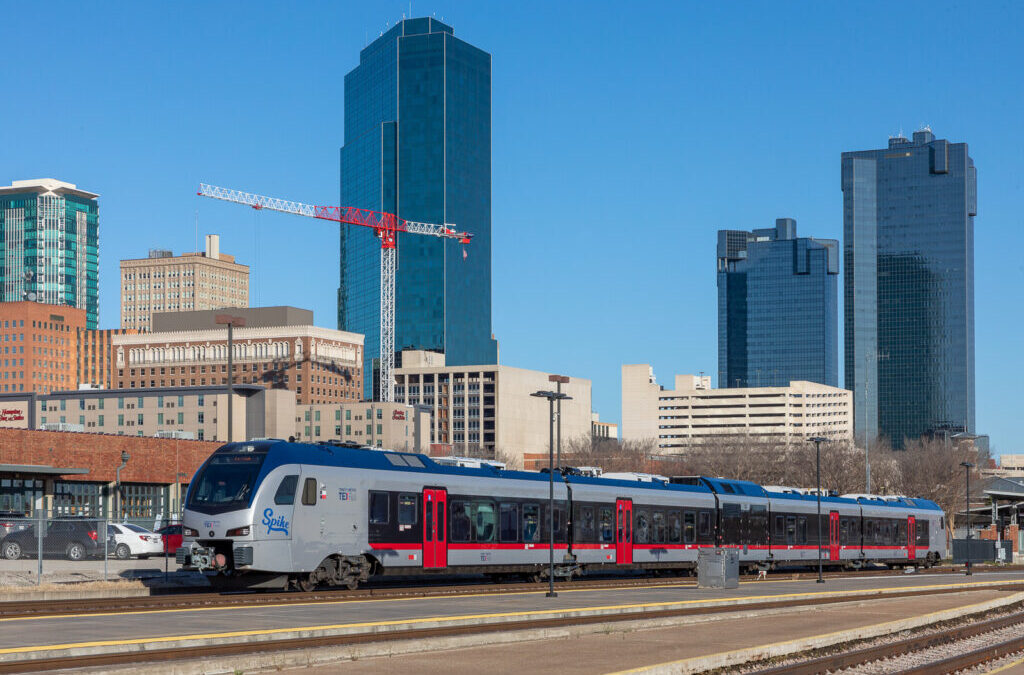
Trinity Metro is using unspent federal funds to help finance a $270 million extension of TEXRail’s commuter service into Fort Worth’s Medical District.
The 2.1-mile project will extend the line south from downtown’s Texas & Pacific (T&P) Station, adding one stop at the new Near Southside Station, with passenger service projected to begin in late 2029. Crews will build a new passenger track, mainly within existing Union Pacific and Fort Worth & Western Railroad rights-of-way. The station site is being donated by Baylor Scott & White Health, which will provide approximately 1.76 acres near its All Saints Medical Center.
Trinity Metro broke ground Oct. 29 at the future station site, advancing a project supported in part by $38.9 million in unspent federal funding from the original TEXRail line. TEXRail operates a 27-mile route with nine stations between downtown Fort Worth and Dallas-Fort Worth International Airport’s Terminal B. It connects at two downtown stations with Trinity Railway Express, a roughly 34-mile, 10-station commuter line between Fort Worth and Dallas that Trinity Metro jointly owns and operates with Dallas Area Rapid Transit.
DART’s larger light rail network spans 93 miles and 66 stations, carrying approximately 22.1 million passenger trips in Fiscal 2025. Its Orange Line has connected downtown Dallas with DFW Airport’s Terminal A since August 2014, nearly five years before TEXRail opened its Fort Worth-to-airport service in January 2019. The ridership figure counts trips rather than individual passengers.
The Medical District extension will bring TEXRail’s station total to 10. Related property agreements with Baylor Scott & White provide access for customer parking, a bus turnaround and a station access road. The agreements also accommodate future development of the hospital campus while protecting long-term parking and access for transit customers.
The project advances part of a transportation vision that predates TEXRail’s opening. The Fort Worth Transportation Authority, now Trinity Metro, examined ways to connect southwest Fort Worth, downtown and DFW Airport in its 2006 Southwest-to-Northeast Transportation Corridor Study. Commuter rail emerged as the preferred approach.
Increasing costs prompted the transportation authority’s board in 2013 to shorten the proposed 37.6-mile route to the approximately 27-mile downtown-to-airport segment. The agency said that decision concentrated its efforts on the portion with the highest potential ridership. Construction began in August 2016, supported by a roughly $1.034 billion funding package.
A $499.39 million federal New Starts grant supplied a substantial share of that original funding. Other contributions included additional federal funding, state money, transportation authority funds, Grapevine sales taxes and Tarrant County bond proceeds. Trinity Metro subsequently reported that the project finished $80.6 million under budget.
Trinity Metro secured federal permission in 2020 to redirect $38.9 million in unspent grant funding toward the Medical District extension. The Regional Transportation Council approved another $40 million in 2026, later clarifying that money would be released by delaying or canceling lower-priority transportation projects. The council’s action helped move the extension toward construction after years of planning.
The expansion comes as Trinity Metro reports growing use of TEXRail by work commuters, airport travelers and day-trippers. In a Sept. 30 announcement, the agency said TEXRail had reached 1 million rides in a single year for the first time in its history, welcoming its millionth ride of 2026 earlier that week. Holiday airport travel and Christmas activities in Grapevine also helped push December 2025 ridership to a monthly record of 129,115 rides.
The extension will serve one of Fort Worth’s major employment centers, with approximately 50,000 people working in the Medical District, according to Trinity Metro. Its health care institutions include Baylor Scott & White All Saints, Texas Health Harris Methodist, Cook Children’s, Medical City Fort Worth, JPS Health Network and UT Southwestern’s Moncrief facilities. The district anchors the broader Near Southside, an approximately 1,400-acre neighborhood that also includes housing, restaurants and other businesses.
Trinity Metro already offers a connection between T&P Station and the Medical District through its Southside On-Demand service. Riders request shared trips within designated boundaries through an app or by phone, paying $2 per ride or using a qualifying transit pass, including the $4 local day pass. The extension will bring the train itself into the district, adding direct rail access for employees, patients and visitors.
The agency overseeing those services was established in 1983 as the Fort Worth Transportation Authority, commonly known as The T. It adopted the Trinity Metro name in 2018 and operates independently of its member cities. Its transportation services include buses, rail, and On-Demand rides.
The Medical District may be another step toward a longer southwest rail corridor. Trinity Metro President and CEO Rich Andreski envisioned extending TEXRail farther south along the Chisholm Trail Parkway corridor, potentially reaching stations near TCU and Tarleton State University’s southwest Fort Worth campus, according to an April Fort Worth Report article. Those additional extensions remain longer-term ambitions contingent on funding.
Photo courtesy of Trinity Metro
This story is part of the weekly Texas Government Insider digital news publication. See more of the latest Texas government news here. For more national government news, check out Government Market News daily for new stories, insights and profiles from public sector professionals.