
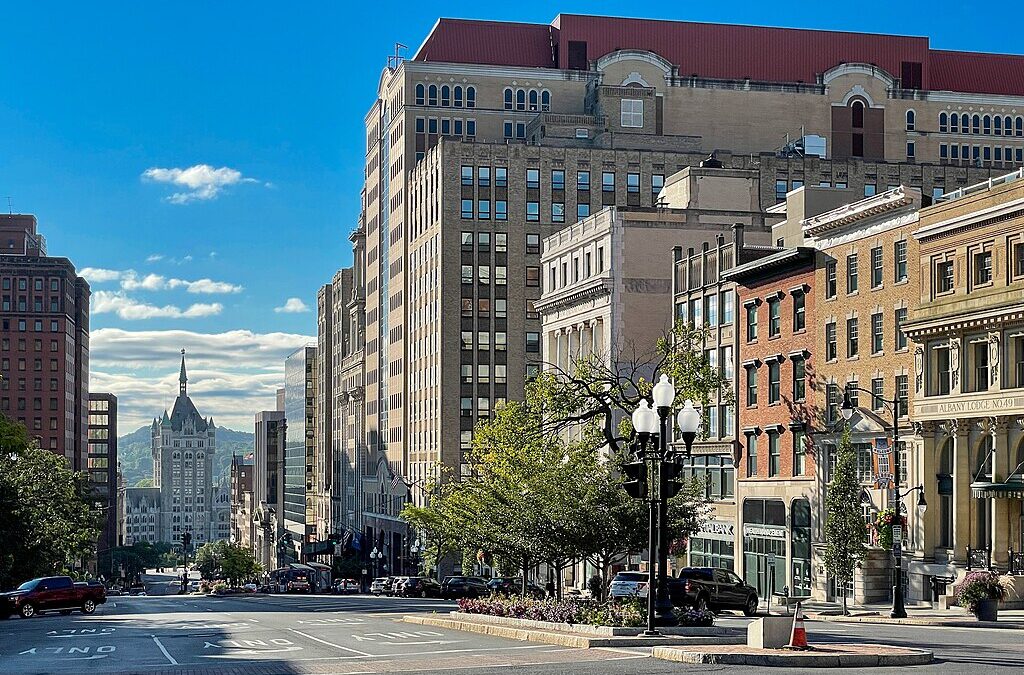
The state of New York has unveiled a $200 million strategy to rapidly advance housing growth markets, revitalizing efforts to attract new residents, promote long-term redevelopment and create jobs as part of the larger $400 million Championing Albany’s Potential (CAP) Initiative.
The $200 million Downtown Albany Strategy (DTAS) targets investments into the city’s Downtown area, providing a foundation for revitalizing the city at large through private development and enhanced residential, cultural and public spaces. The plan divides the funding into three investment groups:
- The Transformative Projects Fund will use $120 million to support major projects designed to enhance the downtown experience and engage public interest in the redevelopment process. These include developing mixed-use buildings, major public space or plaza upgrades and high-leverage mobility or gateway improvements.
- The Housing Investment Fund will spend $40 million to expand housing options to accommodate population growth and a community capable of supporting commercial growth. Typical initiatives supported by the fund will include office-to-housing and mixed-use conversions, major downtown housing development, infill, rehabs, upper-floor conversions and smaller mixed-use housing.
- The Community and Public Spaces Investment Fund will allocate $40 million to improve parks, public spaces and other neighborhood amenities. These projects will be split between commercial district enhancements, beautification and placemaking and community and cultural anchors. Planned investments will target storefront improvements, corridor upgrades, landscaping, wayfinding, seating and shade, community centers, cultural venues and performance spaces.
The DTAS includes seven investment areas where the city will prioritize development and expansion through coordinated action. These areas typically intersect with significant activity, connectivity, redevelopment opportunity and community priorities, making them prime options to gain the greatest benefits from short-term attention and long-term gains.
The first chosen sector is known as Albany’s Downtown Heart, consisting of State and Pearl Streets. The plan targets five separate sections of the site area to transform: State Street; Ten Eyck Plaza; 40 North Pearl Street; Steuben Street Alley, Pearl Street, Broadway, Waterfront Link; and the MVP Arena and future hotel or mixed-use site. Improvements will include:
- Converting offices to residences.
- Improving curbs, pavers and crosswalks.
- Installing bike lanes and stormwater infrastructure.
- Activating ground floor retail, alleys and outdoor areas.
- Installing water features.
- Improving outdoor mobility, transit and seating amenities.
- Building mixed-use developments.
- Improving lighting and public safety features.
The second sector will target the city’s downtown neighborhoods, an area that encompasses one of the plan’s highest priority revitalization spaces: Liberty Park. The 8-acre Liberty Park district will be updated to be build-ready for new infrastructure and provide better connections to the city core and waterfront. This will include modernizing the multi-modal station to welcome arrivals and support nearby investments.
Outside of the Liberty Park district, Albany will prioritize Broadway Landmarks in the neighborhood area, including the SUNY Plaza, SUNY Administration Building Lobby and Federal Building, Kiernan Plaza, Union Station and Columbia Street Garage. Some of the planned improvements include:
- Ground floor event and retail activation.
- Converting a section of the SUNY Plaza into a flexible even and through traffic area.
- Improving pedestrian crossings, connections and the Broadway streetscape.
- Infilling residential development.
- Installing public art.
- Conducting a study to reimagine the nearby Interstate 787.
The Central Warehouse district’s improvements will primarily center around anchor redevelopment of the Central Warehouse, improving Broadway Street connectors to nearby amenities and investing in future nature-based placemaking. The city will advance site readiness to enable catalytic redevelopment and near-term adjacent sites, support phased infill and prioritize a gateway and connector package with crossings, lighting, sidewalks, trees and signage/wayfinding features. Additional amenities will include:
- Expanding the waterfront park.
- Building mixed-use developments.
- Improving waterfront and skyway connectivity.
- Building a bridge.
- Opening Lock 1.
The South End Gateway serves as the “front door” to the city’s downtown area, and as such warrants a significant investment to modernize and expand its amenities. The DTAS includes measures to transform the Lincoln Towers, Albany County Complex and Prince Street/120 Madison Avenue plus 135 South Pearl Street. Notable improvements will include:
- Building the Lincoln Towers mixed-use development.
- Redeveloping the County Complex mixed-use facilities.
- Making public realm and safety improvements on three streets.
- Developing a multi-modal transit station.
- Redeveloping St. John’s Church.
- Making anchor investments in cultural and event spaces.
The city will target a series of corridor investments, upgrades for Townsend Park and improvements to the busiest intersection in the International District. The project vision calls for enhancing crossings, visibility, lighting, signals and wayfinding to improve transit and mobility safety. Additional work will include expanding Townsend Park, improving small business facades, building a single one-way traffic lane, installing a bike lane, expanding curbs, implementing traffic calming measures and branding for the district.
The Center Square sector of the city contains the downtown’s neighborhood street – Lark Steet – emphasizing local accessibility to nearby businesses, nightlife and culture. Plans for this area will include improving Lark Street core blocks and key gateways to enhance safety, upgrading public-space nodes with lighting, wayfinding and seating and capitalizing on infill and revitalization opportunities. Examples of improvements include:
- Enhanced and safer crosswalks.
- Ground floor retail activation.
- Lark Street Gateway branding.
- Bikeshare stations.
- Expanded curbs.
- Improved plantings.
- Public art installations.
The final priority investment zone featured in the DTAS will be the Clinton Square Arts and Heritage District. In order to reuse signature heritage buildings, strengthen walking links with nearby districts and improve the areas lighting, crossings, wayfinding and streetscape, Albany will focus on:
- Improving the North Pearl Street and Broadway public realm.
- Targeting adaptive reuse and building systems upgrades for signature heritage buildings.
- Implementing building improvements for arts, maker and small venue spaces.
- Capitalizing on major redevelopment opportunities for new housing and modern employment spaces.
Planned enhancements will include improving the Palace Theater and building mixed-use developments across multiple buildings. In addition, the city will increase multimodal resiliency, connectivity, build the Clinton Market Collective event infrastructure, bicycle lanes and infill opportunities.
Photo by Kenneth C. Zirkel, CC BY 4.0 https://creativecommons.org/licenses/by/4.0, from Wikimedia Commons
For more of the latest from the expansive government marketplace, check Government Market News daily for new stories, insights and profiles from public sector professionals. Check out our national contracting newsletter here.