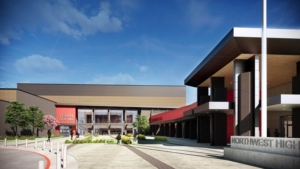
Courtesy of the Northwest Independent School District.
Enrollment data for K-12 school systems in the U.S. can fluctuate dramatically from year to year. Regardless of whether enrollment increases or decreases, the numbers point to demand changes and, more often than not, school officials must address growth with new construction projects.
For school districts with land-ownership portfolios, the most common approach is to construct new facilities. But, when land is not available, officials spend millions to modernize and expand existing facilities.
Along with expansion projects, school districts are also upgrading safety and security systems throughout the country. Unprecedented amounts of funding are designated for projects that reconfigure schools to create single points of entry, add cameras, alert systems that are monitored continually and more.
The federal government’s annual allocation for education for 2023 is $79.6 billion. Along with that revenue, federal funding is still available in many states from the American Rescue Plan Act (ARPA) which allocated $122 billion for education upgrades. School officials in numerous states have tens of millions in ARPA funding still left to spend before a fast-approaching obligation deadline set for 2024. However, that combined amount of funding is far from adequate. Historical data points to an alarming fact –
K-12 spending in the past has exceeded $670 billion annually. State legislatures provide a large source of K-12 funding, and local bond elections also supply much-needed revenue for educational needs.
The fast-growing Northwest Independent School District in north Texas will ask voters to issue $2 billion in bond funding for upcoming school improvements this year. Construction of new facilities and capital improvements carries an estimated cost of $1.7 billion. That effort will deliver four new elementary schools, four early childhood centers, a new middle school and a fourth comprehensive high school.
Voters in North Carolina’s second-largest school district will be asked to support a $2.99 billion bond proposal for school improvements.
Charlotte-Mecklenburg County Schools needs three middle schools (each one expected to cost $73 million), a new $148 million high school facility and an $80 million regional athletic complex. Enhancing safety with various types of projects will also be funded if the bond package is approved.
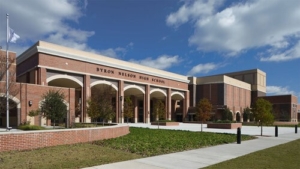
Courtesy of the Northwest Independent School District.
Local leaders in Middletown, R.I., will hold a special election this year asking voters to approve $190 million for construction of a new school facility. The proposed building will reflect the growing trend of consolidating separate schools into one facility. The Middletown project will combine a middle school and high school in a facility large enough to separate classrooms while allowing students to share the auditorium, gym, and athletic fields. This project is currently going through a $2.5 million planning and design phase.
Officials in Pleasanton, Calif., are holding $395 million in funding from a bond package that voters approved late in 2022. That revenue will be used for the construction costs of new school facilities. The projects will include construction of an early education center, an educational options center, and renovations to a middle school athletic field.
Education leaders at the Stillwater Public Schools system in Oklahoma recently decided to proceed with the first phase of construction for a $68.6 million high school building. The project’s schematic design, development and permitting phases are finalized and a newly created design review committee will help guide the project through its final design phase. Once the new facility is completed, officials plan to award a contract for the planning and design of a $15 million renovation of athletic facilities.
The Dripping Springs ISD in Texas will ask voters to approve $223.7 million in bonds for districtwide improvements. Included in the bond package is funding for construction of a sixth elementary school, expansion of a middle school, construction of a special education building and districtwide security upgrades.
Last week, the governor of Pennsylvania proposed a new budget with notable increases in education spending – an allocation of an additional $567 million. A proposed budget for the state of Idaho includes historic levels of funding for education. Compared to last year’s allocation, it will be the largest increase ever in annual discretionary funding for schools. It also awards $20 million in one-time grants to school districts for security upgrades. Lawmakers in South Dakota also passed a bill to give state K-12 funding its largest boost since 2016. Other states are funding education in much the same way and voters throughout the country are supporting bond packages that provide millions for local school districts. Examples of upcoming contracting opportunities point to numerous ways the new funding is scheduled to be spent.
All types of contractors will be in high demand as new educational facilities are constructed. New technology upgrades will be common and safety features of various types will be included in design plans. New construction projects will require professional services, engineering, equipment purchases and landscaping. Upgrading the safety and well-being of students and teachers in 2023 and 2024 will provide an economic boost to communities throughout the country.