
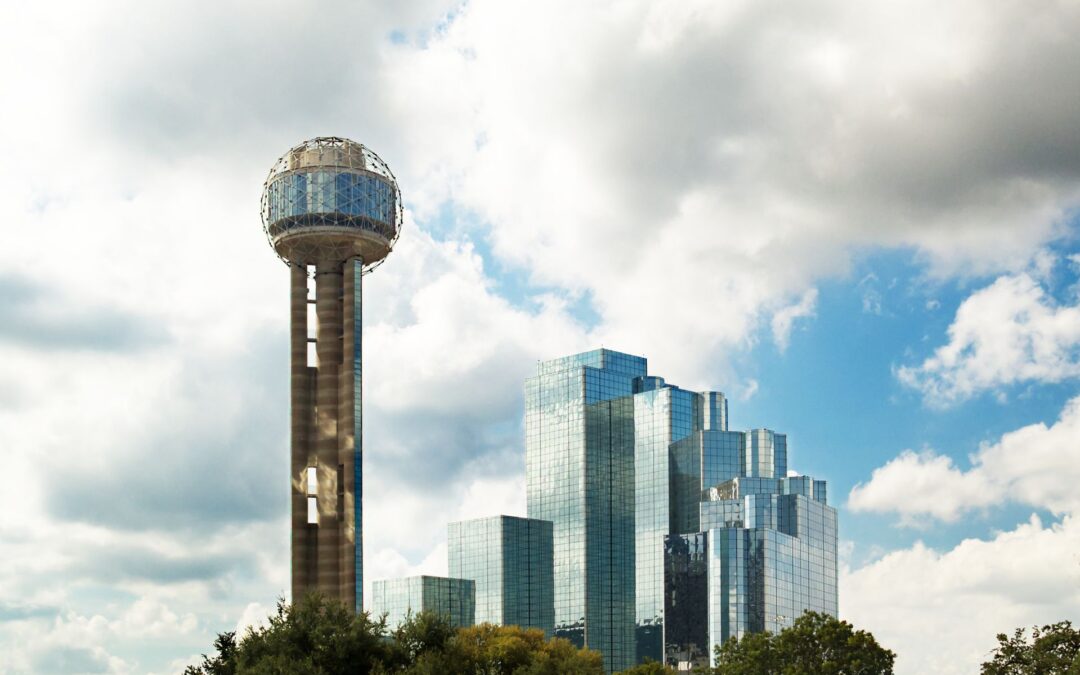
The City of Dallas has officially adopted its Fiscal Year 2026-2027 budget, covering $5.7 billion in capital and operational expenses over the course of the next year. From that amount, the city has carved out roughly $1.3 billion for the capital budget, split between $780.1 million for enterprise fund capital improvements and $523.3 million for general purpose capital improvements.
The Capital Improvement Program (CIP) portioned its annual expenses across nine categories:
- Water utilities facilities – $427.3 million.
- Aviation – $223.5 million.
- City facilities – $167.5 million.
- Economic development – $147.7 million.
- Streets and transportation – $108.1 million.
- Flood protection and storm drainage management – $78.3 million.
- Park and recreation – $73.7 million.
- Convention and event services – $55.3 million.
- Sanitation services – $22 million.
A little more than a third of the entire CIP will go toward water utilities, with a majority of those funds being dedicated to critical infrastructure. These include – but are not limited to – allocating $203.7 million for mains, pump stations and associated facilities; $139.1 million for water treatment plants; and $25.7 million to support rehabilitation efforts and equipment procurement.
The aviation division’s funding – overseeing development at Dallas Love Field (DAL), the Downtown Vertiport (49T) and Dallas Executive Airport (RBD) – will advance efforts to complete construction on ongoing capital projects and to initiate the design phase for upcoming initiatives. These include:
- Designing Taxiway Echo Phase II at DAL.
- Designing major terminal, roadway and passenger facility improvements at DAL.
- Designing airport support and operational facilities at DAL.
- Designing LEAP Space Planning for the Dallas Airport System.
The city’s $167.5 million investment in building, maintaining, expanding and supporting city facilities includes dedicating $62 million to replace fleet vehicles and equipment. Other allocations include $26.5 million for major maintenance work, $17.3 million for technology integration, $16.2 million for library facilities, $16.1 million for cultural facilities and $11.5 million for fire protection facilities. Projects will largely consist of improving facility infrastructure, making emergency repairs, renovating buildings and expanding electrical vehicle (EV) charging facilities.
Plans for advancing economic development over the next year will primarily be driven by three key objectives:
- Implementing the city’s Economic Development Policy 2022-2032 and the Incentive Policy.
- City Council approval of incentive agreements to support catalytic mixed-use and/or mixed-income developments and job creation/retention projects, including small business projects.
- City Council approval of incentive agreement to support the proposed Integrated Community Development Project on city-owned property in the 200-300 blocks of St. Augustine Road in Pleasant Grove.
To achieve these goals, the city will invest in core tax increment financing districts (TIRZ) and other bonding programs. Major selections included in the coming year’s budget include $50.6 million for the Downtown Connection TIRZ, $31 million for economic development bonds, $11.7 million for the Oak Cliff Gateway TIRZ and $10.8 million for the Design District TIRZ.
Street and transportation capital projects cover some of the most impactful investments for FY 2026-2027, including dedicating $44.2 million to reconstruct streets and $32.2 million to improve streets and alleys. Dallas leaders have indicated their interest in fortifying street-level infrastructure, including improving 800 lane miles over the next year.
Dallas has several major plans in store for the coming year, going so far as to highlight some of the more prominent efforts to shore up operational efficacy and capital investment. Outside of improving lane miles, the city will strengthen its transportation network and roadway safety by improving pavement markings, increasing bridge maintenance, delivering warranted signal projects and advancing Vision Zero efforts to reduce severe crashes and fatalities.
Housing occupies another one of the city’s major tickets for the coming year as leaders work to ensure all residents have access to safe, affordable homes. The budget will help the city expand “Dallas Is Home” opportunities through public-private partnerships (P3) models. These efforts will increase production, preserve affordable unites, support homeownership and bolster the homelessness ecosystem.
The city will also place further emphasis on emergency services after increasing the combined budget for the Dallas Police Department and Dallas Fire-Rescue by $82.3 million. The budget includes funding to add 750 officers over the next two years and providing additional city contributions to support the Dallas Police and Fire Pension System and the Employee Retirement Fund.
Photo by Phil Mitchell from Pexels
This story is part of the weekly Texas Government Insider digital news publication. See more of the latest Texas government news here. For more national government news, check out Government Market News daily for new stories, insights and profiles from public sector professionals.