
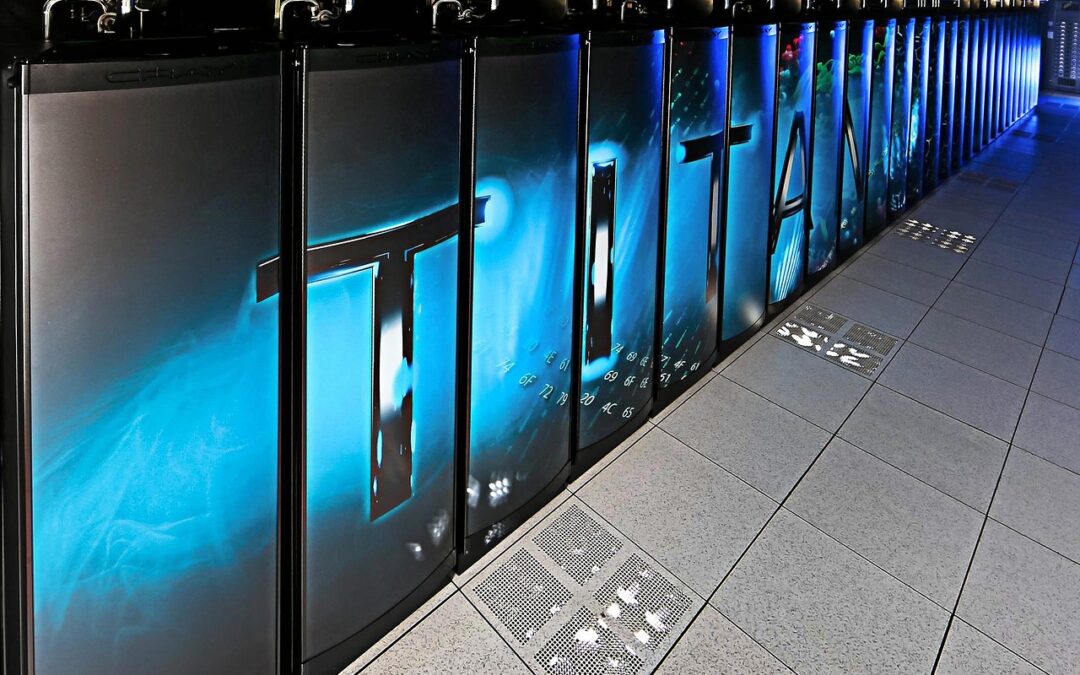
The University of Texas (UT) at Austin will be the site of one of the most powerful supercomputers in academia, eclipsing other institutions in its bid to become a leader in computing power.
A wave of new expansions and installations has launched UT-Austin as the epicenter of technological innovation. The National Science Foundation (NSF) recently announced that it has begun installing Horizon – the largest academic supercomputer in the nation – at UT Austin’s Texas Advanced Computing Center. The supercomputer is expected to come online in 2026.
Through Horizon, researchers will benefit from unparalleled computer and AI capabilities, enabling greater exploration and technological advancement in critical sectors. The supercomputer will function alongside the Ranch – the largest academic storage system in the nation – to push the boundaries on data management at an exabyte scale.
The work is funded by a $20 million investment from the Texas Legislature to advance AI infrastructure construction. The university has partnered with the NSF, Dell Technologies, NVIDIA and Sabey Data Centers to bring these projects to fruition. This historic collaboration positions UT-Austin as a world-class resource for driving innovation and groundbreaking discoveries.
UT-Austin has skyrocketed as the premier site for advanced research and development by implementing emerging technologies, soaring past 5,000 graphic processing units (GPUs) amassed across its facilities. The university recently acquired more than 4,000 NVIDIA Blackwell architecture GPUs – the most powerful on the market – alongside high-performance Dell PowerEdge servers to expand its capabilities to drive agentic and generative AI development processes.
With these technologies at researchers’ beck and call, UT will be one of the foremost producers of open-source large language models to power and advance modern AI applications. Areas of advancement will include AI, quantum information science, semiconductors and microelectronics, future computing technologies and advanced manufacturing.
The expansion comes on the heels of the university doubling the computing capacity to more than 1,000 advanced GPUs at the Center for Generative AI. The center will be used exclusively for UT faculty and student researchers, providing the latest and most powerful resources available to advance discoveries in biosciences, healthcare, computer vision, vaccine development, advanced medical imaging and video quality, personalized medicine and accurate computer processing of human language.
Photo by Pixabay
This story is a part of the weekly Texas Government Insider digital news publication. See more of the latest Texas government news here. For more national government news, check Government Market News daily for new stories, insights and profiles of public sector professionals.