Volume 14, Issue 33 - Wednesday, August 17, 2022 |
|
By Mary Scott Nabers, CEO of Strategic Partnerships, Inc. |
|
Bike trails and greenway projects no longer represent inconsequential amounts of funding. In fact, these types of projects now represent a spending impact that exceeds $10.6 billion annually. Data indicates trail development projects that encourage hiking, biking, and walking result in numerous benefits and can be credited for about $20 billion in health cost savings.
Between 2021 and 2022, federal funding for transportation alternatives such as bikeways and trails increased from $850 million per year to $1.4 billion annually. Numerous other funding sources also fuel this trend. Various types of public-private partnerships have recently become linked to bikeway corridors and now some of these trail projects are beginning to rival highways and interstates projects, at least in terms of their geographic scope.
Perhaps the most notable example of this trend is the East Coast Greenway plan to deliver 3,000 miles of bike and pedestrian trails along the Atlantic seaboard. Segments of the project are already in various stages of development in fifteen states and the District of Columbia. Funding representing hundreds of millions is being consolidated from federal, state, and local sources.
One of the individual segments of the Greenway project is a rails-to-trails project in North Carolina. City leaders in Durham have committed to converting 1.7 miles of inactive railroad into a trail that connects greenspaces throughout the city. The trail will also provide a forum for public art installations and other citizen benefits. An estimated price tag of $16.3 million is attached to the project and work is scheduled to begin in 2023.
|
|
Billion-dollar Inflation Reduction Act signed into law |
|
Washington, D.C. - President Biden signed the Inflation Reduction Act on August 16. The bill invests $370 billion in spending and tax credits in low-emission forms of energy to fight climate change.
It includes $60 billion for boosting renewable energy infrastructure in manufacturing, like solar panels and wind turbines, and includes tax credits for electric vehicles and measures to make homes more energy efficient.
According to the Council of State Governments, the bill establishes the Alternative Fuel and Low-Emission Aviation Technology Program. This program includes competitive grants that state and local governments are eligible for, such as $245 million for projects relating to the production, transportation, blending, or storage of sustainable aviation fuel and $47 million for projects relating to low-emission aviation technologies. The bill also provides funding for the following:
- $7 billion for competitive Greenhouse Gas Reduction Fund grants for state, local, and tribal governments and other entities to support low-income and disadvantaged communities in benefiting from zero-emission technologies.
- $4 billion to mitigate the impact of droughts in reclamation states.
- $2.6 billion for coastal state, local, and tribal local governments and other entities to support coastal community preparation for extreme weather.
- $2.3 billion to state, local, and tribal governments to reduce air pollution in ports.
- $1.9 billion to the Federal Highway Administration for the competitive neighborhood access and equity grant program to fund a variety of safety, environmental quality, and transportation accessibility initiatives. States and other entities are eligible.
- $1.3 billion for projects in economically disadvantaged communities. These projects are to be administered by state transportation departments.
- $760 million for grants to state, local, and tribal governments and other entities to support accelerated siting of interstate electricity transmission lines.
- $550 million for grants and other financial assistance to disadvantaged communities for the development of water supply projects.
|
|
$45M in innovative technology grants to improve mobility |
|
Washington, D.C. - The U.S. Department of Transportation’s Federal Highway Administration (FHWA) and Federal Transit Administration (FTA) together awarded $49.2 million in innovative technology grants to improve mobility and multimodal connections. Grants can be applied to technologies ranging from systems that detect and prevent wrong-way crashes to advanced technology to improve trucking operations and terminal operator activities at a port.
The FHWA awarded $45.2 million in Advanced Transportation and Congestion Management Technologies Deployment (ATCMTD) grants to 10 projects using advanced intelligent transportation systems (ITS) technologies that improve mobility and safety, reduce congestion, and support underserved communities.
The FTA awarded $4 million in Enhancing Mobility Innovation (EMI) grants to nine transit agencies and organizations in six states and the District of Columbia to improve access and mobility for transit riders.
Some of the awardees include the South Jersey Transportation Authority who will receive $8.74 million for a smart and connected corridor project. The project will focus on transforming the existing Atlantic City Expressway to serve transportation users and surrounding communities safely and efficiently. The primary focus will be to deploy and evaluate compatible cellular vehicle-to-everything technologies to support future connected and automated vehicles.
The Kansas Department of Transportation will receive $6.67 million for its Great Plains rural freight technology corridor project. The project will improve safety and economic productivity on U.S. 83, a two-lane corridor critical to freight transport in Kansas. The project installs 100 miles of fiber-optic cable and advanced technologies to deliver traffic, weather, and other operational information to commercial trucking to optimize freight routing.
The University of Maryland-College Park will receive $800,000 to develop a software application for transit agencies to generate tradable credits from emission reductions and social equity improvements. These emission and equity credits will be integrated into a mobile app that uses real-time data to determine their credits and value.
The Metropolitan Transportation Commission in San Francisco, will receive $500,000 to develop a new software application that facilitates end-to-end demand responsive transit trip planning and reservations so users can request, confirm, and pay for a trip that encompasses multiple service providers across jurisdictions, and service providers can confirm and coordinate trip segments.
|
|
Illinois invests $34.6B in six-year program supporting transportation |
|
Illinois - The Illinois Department of Transportation (IDOT) has announced its $34.6 billion six-year spending plan for roads, bridges, rail, ports, transit, and airports. Overall, Illinois’ infrastructure has a C-rating, and deferred maintenance backlogs for road and transit systems alone have reached $30 billion, according to IDOT.
The multi-year plan is funded in-part by the Rebuild Illinois program and federal investment. According to IDOT, more than 2,500 miles of road and nearly 10 million square feet of bridge deck area will be reconstructed or rehabilitated through the program.
Rebuild Illinois includes: $25.4 billion for Illinois’ roads and bridges, $1.4 billion for major rail projects and added Grade Crossing Protection projects, $150 million for aeronautic facility improvements, and $150 million in new funding for port improvements.
The current fiscal year, which began July 1, is scheduled to see $3.7 billion in new construction under the road and bridge plan.
The plan includes $337.3 million through 2028 for work on Interstate 270 over the Mississippi River and to the Chain of Rocks Canal Bridge in Madison County. Work includes reconstructing 1.4 miles of I-270, bridge approach roadway, preliminary engineering, engineering for contract plans, and construction engineering.
Other major Riverbend projects in the plan include:
- $76.5 million for I-270 work from Chain of Rocks Canal to east of St. Thomas Road in Madison County.
- $20.4 million for U.S. 67 over Apple Creek Overflow south of White Hall in Greene County.
- $19.6 million for Illinois 167/152 at Judy's Branch Creek in Madison County.
|
|
New York Power Authority accelerates projects through funding |
|
New York - Advanced funding from the New York Power Authority to the Erie Canal Harbor Development Corporation (ECHDC), through relicensing agreements tied to the operation of the Niagara Power Project, will jumpstart four major projects on the Outer Harbor and at Canalside. ECHDC has identified Wilkeson Pointe, the Bell Slip, the Gateway Building at Canalside, and the Buffalo Riverwalk feasibility study as initial priorities for use of this funding.
The Buffalo Riverwalk feasibility study is currently underway with a final report coming this fall. The Buffalo Riverwalk will consist of a system of universally accessible and elevated walkways, fishing piers and dock level promenades along the Buffalo River, and Kelly Island shoreline connecting Canalside and the Outer Harbor.
ECHDC will invest $10.61 million to reconstruct Wilkeson Pointe to provide permanent amenities and refined spaces for programming and events. The project will begin in fall 2023 and be open to the public in 2025. A permanent, seasonal comfort station including food, beverage, and restrooms will be constructed with ancillary seating areas consisting of decks, lawns, and sand areas.
ECHDC will invest $12.61 million in a multi-story, brick structure, built along the northern edge of the Main Canal and fronting the Commercial Street Bridge and Immigrant Steps. The Gateway Building will be the first stop for all visitors, providing information, public restrooms and ADA accessibility between the two-level Canalside site, while consolidating waterfront operations at the same location.
Other projects receiving funding include $25 million in upgrades to Buffalo Harbor State Park with the installation of a splash pad near the existing playground and shade structures.
The former Delaware, Lackawanna, and Western Trainshed will receive $87.5 million for reuse and reactivation. Phase 1 will be completed soon with Phase 2 set to be completed in 2024. There also will be a third phase.
|
|
Heller joins SPI consulting team |
|
Melissa Heller brings more than twenty years of Florida local government knowledge and experience to her consulting role with Strategic Partnerships, Inc.
Most recently, she was a deputy city manager and finance director for the city of Coral Springs, where she supported the achievement of strategic priorities within the Parks and Recreation Department, Economic Development Office, and Finance Department. Melissa authored the City’s COVID Reopening Plan, which outlined work plans for all City operations as local requirements changed and medical guidance evolved. She was the liaison to the Chamber of Commerce and chaired the Economic Recovery Task Force that was established in early 2020 to support businesses during COVID. Additionally, she was the lead negotiator on two collective bargaining agreements and a multi-million-dollar contract for a public safety communication system.
Prior to that, Melissa spent 12 years with Broward County in increasingly responsible roles related to financial management, internal service delivery, and the purchase and implementation of new software solutions. As the municipal bond administrator and the deputy chief financial officer she gained extensive experience in public procurement, issued $2 billion in municipal bonds, and was an integral part of negotiating a contract for security and law enforcement services at Port Everglades.
Melissa earned a Bachelor of Arts in Government and Women’s Studies from Cornell University and a Master of Public Administration from the Maxwell School of Citizenship and Public Affairs at Syracuse University.
|
|
FEMA programs help combat climate change |
|
Washington, D.C. - The Federal Emergency Management Agency (FEMA) recently announced the recipients of the Fiscal Year 2021 pre-disaster hazard mitigation grants from their Flood Mitigation Assistance (FMA) and Building Resilient Infrastructure and Communities (BRIC) programs. These grants are open to all communities to help fund mitigation actions to combat climate change and protect communities that are vulnerable to disaster.
The city of Virginia Beach, Virginia, will receive $25.1 million to fund the Eastern Shore Drive Drainage Improvement Project which has seen an increase in storms impacting the area. The project will include several infrastructure improvements.
The city of Philadelphia, Pennsylvania, will receive $25 million for the final phase of the Cohocksink Flood Mitigation Project which will include the construction of new sewer infrastructure and green stormwater infrastructure systems in the flood prone Northern Liberties, Ludlow, and South Kensington neighborhoods.
The District of Columbia Water and Sewer Authority will receive $20.3 million to fund a project at the Blue Plains Advanced Wastewater Treatment Plant (AWTP). Three floodwall segments will be built to complete a floodwall system for DC Water. It will provide the Blue Plains AWTP with flood risk mitigation against the 500-year flood event, plus three feet of freeboard to account for wave action and sea level rise.
FEMA also has announced Fiscal Year 2022 funding availability for two resilience grant programs for more than $3 billion. The funding level for the BRIC annual grant program will more than double to nearly $2.3 billion. The FMA program is seeing a five-fold increase to $800 million. These levels are bolstered by nearly $900 million through the Bipartisan Infrastructure Law: $200 million for BRIC and $700 million for FMA. Applications for these grants are due by January 27, 2023. |
|
Nevada airport develops plan for renovations |
|
Nevada - The Reno-Tahoe International Airport has renovations planned to match its growth and approved a multi-year plan at the beginning of 2022 to modernize key aspects of the airport. This includes a new parking garage, a ticketing hall, area for dropping off and picking up passengers, and two new concourses.
The expansion of the ticketing hall will begin in September at an estimated cost between $20 million and $30 million. The pickup and drop-off lanes also will be reconstructed this year. Crosswalks will be consolidated, ADA requirements will be met, and shade structures will be added.
A four-story parking garage, estimated between $175 million and $225 million, will begin in 2024. The garage will house a new consolidated rental car (CONRAC) facility and ground transportation center (GTC) for additional room for rental cars and a space for travelers to leave vehicles while traveling. The facility will consist of four floors at approximately 180,000 square feet each.
Building two concourses is estimated to cost more than $300 million and will include retail stores, food vendors, a larger sitting area for waiting passengers, and an expanded Customs and Border Protection facility. The current concourses were built in 1980 and are outdated and too small to meet passenger demand.
|
|
California releases $8B water strategy plan |
|
- Creating storage space for up to 4 million acre-feet of water to capitalize on big storms when they do occur and store water for dry periods.
- Recycling and reusing at least 800,000 acre-feet of water per year by 2030, enabling better and safer use of wastewater currently discharged to the ocean.
- Freeing up 500,000 acre-feet of water through more efficient water use and conservation, helping make up for water lost due to climate change.
- Making new water available for use by capturing stormwater and desalinating ocean water and salty water in groundwater basins, diversifying supplies, and making the most of high flows during storm events.
- Increasing desalination of brackish water by 28,000 acre-feet per year by 2030 and 84,000 acre-feet per year by 2040. An acre-foot of water can serve on average three Southern California households for a year.
These actions were identified broadly in the Water Resilience Portfolio – the state’s master plan for water released in 2020 – but they will be expedited given the urgency of climate-driven changes.
A key theme of the strategy is expediting permitting for a range of projects, including groundwater recharge and desalination. Due to continued drought, the state prepares to lose 10 percent of its water supply by 2040, according to projections by the Department of Water Resources.
|
|
Oklahoma City Public Schools to hold $955M bond election in November |
|
Oklahoma - Oklahoma City Public Schools is calling for a bond election November 8. If approved, it would be the largest in the history of the district and pay for $955 million in improvements across the district.
The school board’s vote enables school district officials to ask Oklahoma City voters to consider the following two propositions:
$936 million to provide funds for acquiring, constructing, equipping, repairing and remodeling school buildings, acquiring school furniture, fixtures and equipment, and acquiring and improving school sites; or an alternative of acquiring all or a distinct portion of such property pursuant to a lease purchase arrangement;
$19 million for acquiring transportation equipment; or an alternative of acquiring all or a distinct portion of such property pursuant to a lease purchase arrangement.
Some of the projects include a new Belle Isle High School; a new middle school combined with Wheeler Middle School; renovation of the soccer field at Capitol Hill High School; cafeteria renovation, new outdoor eating courtyard, and auditorium renovation at the Classen School of Advanced Studies Middle School; five classroom additions and a competitive gymnasium addition at Bell Isle Enterprise Middle School; and more.
|
|
RAISE grants improve transportation in North Carolina |
|
North Carolina - The state will receive nearly $60 million in federal funding to help improve transportation. This funding comes from Rebuilding American Infrastructure with Sustainability and Equity (RAISE) grants.
Major projects that will receive funding include:
- $10.7 million to reconstruct 28 bridges in western North Carolina. This will help fix low-water bridges in six counties to better function during floods and other weather events.
- $20 million to transform the corridor from Rutherfordton to Spindale into a Complete Street. RAISE funds will help improve bicycle, pedestrian, and transit in Rutherford County.
- $18 million to construct a new intermodal facility at Wilmington port that will enable the loading and discharging of supply containers on and off trains at the port.
- $6 million to construct a 1.2-mile extension to the Long Branch Trail in Winston-Salem. The extension aims to reduce pedestrian and bicycle-related crashes in an underserved community.
- $3.4 million for the planning of mobility hubs in seven communities along the S-Line, a rail corridor between Raleigh and Petersburg, Virginia.
Other projects across the state also will receive funding through the RAISE program. The RAISE program was the first discretionary grant program for which applications were accepted under last year’s $1.2 trillion Infrastructure Investment and Jobs Act.
|
|
Indiana University plans for renovations/maintenance
|
|
Indiana - The Indiana University (IU) Board of Trustees has approved IU's 2023-25 legislative capital request. This request for state funding focuses on renovation projects to provide students and faculty with the best opportunities by renovating classrooms, labs, and other campus spaces.
Major projects listed within this request include:
- $89.5 million for the renovation of Wells Quad-Public Health, which will renovate portions of Wells Quad and School of Public Health facilities on the Bloomington campus. Student spaces will be updated with the latest technology, and new energy-efficient building systems will be installed.
- $27 million for IU School of Nursing infrastructure renovations. This project will renovate the School of Nursing located on the Indiana University–Purdue University Indianapolis (IUPUI) campus. Classrooms, the auditorium, learning spaces, and bathrooms will be renovated and updated.
- $65 million for research laboratory infrastructure renovations. Research laboratories in four STEM-focused buildings, including science, technology, engineering, and math, will be renovated on the Bloomington campus.
- $25 million for regional campus deferred maintenance will continue the university's commitment to addressing repairs and renovations of facilities and infrastructure through projects impacting 16 buildings on five campuses.
The university has also approved its 10-year capital project plan for all campuses. This plan lists anticipated repair and rehabilitation projects and new construction projects from 2023 to 2032.
|
|
Study underway on $113M expansion of Legislative Hall |
|
Delaware – A Legislative Hall Building Committee, formed in 2021, is studying a list of needs and building plans and working with an architecture and engineering firm to decide if the size of the current Legislative Hall should grow.
A recommendation will be made by October 1, 2022 on whether to spend $113 million to increase the size of the Legislative Hall and build a 350-vehicle parking garage. The last major renovation and expansion at Legislative Hall was completed in 1998.
The most recent proposal includes:
- A $22 million parking garage on the site of the parking lot near Del One Federal Credit Union at the corner of Water Street and Martin Luther King Boulevard South.
- Funding needed for a pedestrian tunnel under Martin Luther King Jr. Boulevard South from the parking garage to Legislative Hall.
- A $29.5 million addition to Legislative Hall at a new main entrance to the building, more office space, meeting rooms, bathrooms, and a new cafeteria.
- An open-air courtyard surrounded by the existing building and the addition with landscaping that requires minimal maintenance, mostly raised beds, pavers, and ornamental trees.
If the project is approved, construction on the parking structure would start in August 2024 and last until December 2025. Work on the addition to Legislative Hall is scheduled from July 2025 to June 2027.
|
|
D.C. transit projects receive federal funding |
|
Washington, D.C. - Multiple projects in the Washington region will receive nearly $60 million in federal funding from the Rebuilding American Infrastructure with Sustainability and Equity (RAISE) program. Projects funded by the program aim to improve conditions for pedestrians, bicyclists, and public transport.
One of the largest projects to receive funding is the $2 billion Long Bridge Project. This project spans over the Potomac River and will add a new connection in a busy corridor for pedestrian and bike traffic, add new rail tracks, and double the capacity for train traffic between D.C. and Virginia by 2022.
Another project receiving funding is a proposed bicycle and pedestrian crossing that will create a walkable connection between Northern Virginia’s growing Crystal City neighborhood and the District’s Southwest Waterfront. The project will receive $20 million in federal grants. In Southeast Washington, a 3.8-mile trail is receiving $10 million, just under half of the project budget. Prince George’s County will receive $20.5 million to enhance bus connection, add sidewalks and biked land, and improve access to North Carrollton station.
Nationwide, 166 projects will get funding under RAISE, which is receiving an infusion of $7.5 billion over five years from the Bipartisan Infrastructure Bill.
|
|
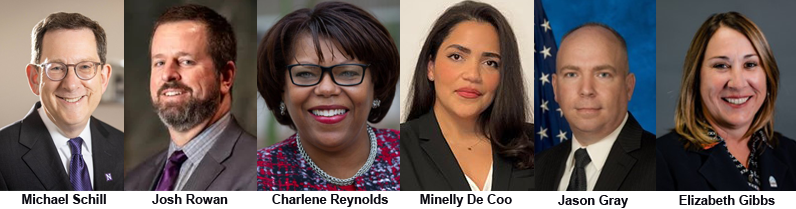
Illinois - Northwestern University selected Michael Schill to be its 17th president, 16 months after Northwestern President Morton Schapiro announced his intention to retire. Schill, who has led the University of Oregon since 2015, has a tenured faculty appointment in the University of Oregon School of Law. He previously was the dean and Harry N. Wyatt Professor of Law at the University of Chicago Law School, dean of the UCLA School of Law, and was a chaired professor at NYU and the University of Pennsylvania.
Georgia - Josh Rowan was named deputy general manager of the Metropolitan Atlanta Rapid Transit Authority (MARTA) and began his position August 15. Rowan has 26 years of program and construction management experience delivering more than $5 billion in facility and infrastructure projects, most recently serving as general manager of Atlanta’s City Renew/ Transportation Special Purpose Local Option Sales Tax (TSPLOST) Program and commissioner of the inaugural Atlanta Department of Transportation.
California - John Wayne Airport officials welcome Charlene Reynolds as the newly appointed airport director. Reynolds boasts over 20 years of experience in both the public and private sectors. She comes to Orange County after serving as the chief commercial officer of the Houston Airport System, and previously working for the Phoenix Sky Harbor International Airport as the Interim and Assistant Aviation Director. She also worked for the city of Phoenix for 15 years in the transportation department and the city manager’s office.
New York - Minelly De Coo was recently appointed as the Deputy Director of Infrastructure. In this role, she leads statewide coordination and implementation of various Federal Bipartisan Infrastructure Law-funded programs, as well as provides strategic support on priority construction projects. Prior to joining the state, Minelly served as director of capital projects at the New York City Mayor's Office. She began her career in engineering consulting working across a broad range of transit, bridge, and facility development projects.
Washington, D.C. - Outgoing Department of Education Chief Information Officer (CIO) Jason Gray joined the U.S. Agency for International Development (USAID) as it’s CIO August 15. Gray will become the first permanent CIO at USAID following the departure of Jay Mahanand in January. Gray previously held a variety of federal government technology leadership positions, including as chief information officer of the Defense Manpower Data Center. Other senior posts include a spell as chief information officer of the Miami VA Healthcare System and as chief technology officer of the National Naval Medical Center.
California - Elizabeth Gibbs was officially promoted to the city manager of Beaumont on August 2. Gibbs had been filling in as the interim city manager after the previous City Manager Todd Parton and the city parted ways last April. She also filled in as an interim city manager in 2015. Gibbs initially began working for Beaumont in 1996, and is the city’s former transit director. She formerly ran a sole proprietorship landscaping company and served previously as a substitute teacher in the Beaumont school district.
|
|
|
|
Connect with SPI
Check out our social media links!
|
|
About Government Contracting Pipeline |
|
Strategic Partnerships, Inc.
Ph: 512-531-3922
|
|
Government Contracting Pipeline, a publication of Strategic Partnerships, Inc., is a free, weekly newsletter detailing important happenings nationwide and the premier source for federal, state, and local government news and contracting opportunities.
|
|
Help us share this message.
To ensure delivery and proper formatting of the newsletter, be sure to add editor@spartnerships.com to your safe senders list.
Otherwise, the newsletter may be flagged as spam and automatically routed to your junk e-mail folder.
|
|
© 2022 Strategic Partnerships, Inc. All rights reserved.
|
|
|
|
|
|
|
|