Perry wants businesses to put I-69 on fast track
Gov. Rick Perry on Thursday announced an ambitious plan to partner with the private sector to develop an interstate-quality highway corridor with additional rail lines that would connect North and South Texas and ultimately run to Indianapolis.

I-69, which has been in the planning stage for 12 years but lacked federal funding, would run from the Lower Rio Grande River Valley to I-37 and continue along the south and east portions of Texas from Corpus Christi through Houston all the way to northeast Texas. Planners at the Texas Department of Transportation (TxDOT) have said recently that they are investigating several financing options, including having the private sector foot the bill.
"We have no better choice than public-private partnerships," Perry said. "For decades Texas has relied on the private sector to finance and build our telecommunications and utility infrastructure. It's time we harnessed the private sector to finance our roads and railroads, too."
The Texas Department of Transportation has been studying the so-called 'NAFTA Superhighway' to determine how to minimize the project's environmental impact. The study is approaching the half-way point. If the massive highway is built, Texas will benefit from unprecedented trade opportunities, a faster, more reliable transportation system, and thousands of new jobs, Perry said.
City plan could upgrade Cotton Bowl
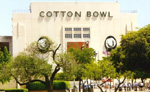
Dallas' Cotton Bowl would expand by 21 percent under a $49 million plan presented to the Dallas City Council this week. The plan emerged after threats by the University of Texas and the University of Oklahoma to pull the annual Texas-OU rivalry game out of the Cotton Bowl if the city doesn't make improvements.
The proposed improvements would increase the stadium's capacity to 92,100 seats from 76,100, and add a new scoreboard, restrooms, concessions, video boards, sound system and new club seats. Rumors and speculation continues that UT and OU may move their game to Arlington, where a new stadium is being built for the Dallas Cowboys.
M.D. Anderson snags $20M gift

Lowry Mays, co-founder of one of the nation's largest radio station chains, has donated $20 million The University of Texas M.D. Anderson Cancer Center. The funds will go toward the development of M.D. Anderson's research park. The donation comes just five months after Red and Charline McCombs donated $30 million to M.D. Anderson in the largest gift ever made to support cancer research at the institution. M.D. Anderson said the gift, plus recent donations, puts the institution at the halfway mark of its initiative to raise $100 million in philanthropy to help fund the research expansion project.

BCS trophy coming to Austin
The coveted Bowl Championship Series (BCS) trophy that will be presented to the winner of the 2006 Rose Bowl will be in Austin on Tuesday, December 13 for the benefit of Toys for Tots. ADT, the trophy's sponsor, will showcase the trophy in the lobby of the Hyatt Regency on Town Lake from 2:30 p.m. to 6 p.m. Volunteers from the Toys for Tots program, which is conducted by the U.S. Marine Corp Reserve, and the Salvation Army will be on hand to accept toys and take donations. Local Fans are encouraged to come and see the trophy and have their picture taken with it. There will be no charge for pictures, however, fans are encouraged to bring at least one new, unwrapped toy.
Sustainable development funding available
The North Central Council of Government's Regional Transportation Council recently allocated $40 million to promote development types that reduce the overall demand for transportation infrastructure and improve air quality. Funding will be allocated through a call for projects, and is available for transportation infrastructure improvements related to sustainable development projects, land banking, and local sustainable development planning programs. For more information regarding the call for projects, including submission procedures and eligibility criteria, visit this Web site. All project submissions are due at NCTCOG by 5 p.m. on January 20, 2006.
Gulf Coast RCIC taking applications for ETF funding
Houston-area companies will be able to start filing applications for the second round of funding for the Texas Emerging Technology Fund starting Dec. 12. The Gulf Coast Regional Center of Innovation and Commercialization will accept the applications until 10 a.m. on Dec. 22.
Companies eligible for the ETF funding should be legally formed and have some prior scientific/technical validation, either via protected intellectual property or prior grant funding. In addition, proposals submitted must be in collaboration with at least one, public or private, Texas university. The GCRCIC has launched a www.gulfcoastrcic.org Web site that provides information and assistance in the application process.

Lens on State Government: Interim Charges
The August 19th column explained that Texas state government operates on a biennial cycle with sessions (meaning regular sessions of the legislature) serving as every-two-year mile markers and interim being the term used to describe the time between sessions.
Traditionally, both the Lieutenant Governor and the Speaker issue "interim charges" to the standing committees of their respective chambers, and in some cases, create interim committees or interim joint (House and Senate) committees to look into specific matters. Three charges were issued during the 1st session in 1846, including one "to collect and destroy all official seals of the various departments of the Republic of Texas." During the 78th interim in 2003, over three hundred charges were issued. That number is likely to be exceeded this year.
Click here to read the rest of the article.
Texas needs at least 2,500 more prison guards

Criminal justice experts expect that the 2007 Texas Legislature must address two issues facing the Texas Department of Criminal Justice: too many prisoners and not enough officers. As of Oct. 31, the system had 23,558 correctional officers and 2,766 vacancies, according to TDCJ. As of Nov. 27, the Texas system was filled to 96.91 percent of its capacity with 151,299 inmates.
"The Legislature is going to have to do better by benefits and salaries for employees. We're about 2,500 prison guards short, and I think largely because of the benefits. A lot of the employees work long overtime, and I don't think you can sustain that indefinitely," said Sen. John Whitmire, chairman of the Senate Criminal Justice Committee.
Texas Tech secures wind-energy funding

Texas Tech University will participate in research that could ultimately free the U.S. from its dependence on foreign oil for energy, according to U.S. Sen. Kay Bailey Hutchison. Hutchison recently announced a $1.5 million appropriation to the school's Center for Wind Science that she said would allow Tech professors to better focus on wind energy. The appropriations come after Congress passed an energy bill that made alternative sources a priority, she said.
Austin strives for a cohesive downtown plan
Austin Mayor Will Wynn, Council Member Brewster McCracken and Williamson County state Rep. Mike Krusee want the city to create a more cohesive, densely packed, walkable downtown by hiring a national firm to craft a downtown planning strategy.
The firm would study just about everything, including ways to encourage taller, denser buildings; the potential for redeveloping government-owned land; transit options, such as a downtown streetcar or light-rail system; and infrastructure needs, like better sidewalks.

McCracken (pictured) said the strategy will be put into ordinance form, with specific goals for the city to meet, so that it won't just sit on a shelf and collect dust. The study could take 12 to 18 months, he said, and will be a vision for the next five to 10 years of downtown growth. A council subcommittee made up of McCracken and council members Betty Dunkerley and Lee Leffingwell approved the idea Tuesday, and the full council will vote on it next week.
Report: Texas per-pupil spending down
Texas was the only state to spend less per student on public schools during the 2004-05 school year than during the previous year, according to a recent report from the National Education Association.
According to Rankings & Estimates: Rankings of the States 2004 and Estimates of School Statistics 2005, Texas spent $7,142 per student in 2004-05, down from $7,214 in 2003-04. Nationwide, spending per public-school student ranged from $15,073 in the District of Columbia to $5,245 in Utah.
Other organizations, including the Texas Education Agency, have listed different per-pupil expenditures during the same years. Agency figures show that spending increased from $7,174 per student in 2003-04 to $7,358 in 2004-05.
Friendswood ISD bond package heading to voters
Voters in the Friendswood Independent School District near Houston will consider on Tuesday an $8.25 million bond package to, in part, replace a variety of equipment used in district facilities. About $5.5 million will be used to purchase new equipment such as roofing and air systems; the remainder will go toward debt repayment.
Texas ranks high in health-crisis readiness
Texas is among the best-equipped states in the nation to handle a large-scale health disaster, a nonprofit health organization reported this week. While the report by the Trust for America's Health gave the federal government a sub par D-plus on health-crisis preparedness, Texas ranked among the eight best-prepared states in the group's third annual report on protection from widespread health catastrophes.
Texas, the report says, has enough scientists to test for diseases such as anthrax, is able to track disease outbreaks electronically, has put vaccinations for hospital workers at top priority, and is one of the few states that could promptly distribute medicines from an emergency stockpile if needed. However, the group warned that Texas is poorly equipped to respond to a chemical attack or to use non-medical facilities to treat victims if hospitals are overwhelmed.

Powers named president of UT-Austin
The governing board of the University of Texas System made it official this week: William C. Powers Jr. will be the next president of UT-Austin. The appointment of Powers, dean of the law school at the flagship campus for about five years, came as no surprise because he had been named by the UT System regents as the sole finalist for president. He will replace Larry Faulkner on January 31, who has been president for more than seven years and who is stepping down to become president of the Houston Endowment, a charitable foundation.
34,000 in Texas still in hotels
A little more than 34,000 hurricane evacuees remain in hotels and motels in Texas as Federal Emergency Management Agency officials continue to move those displaced by Hurricanes Katrina and Rita into more permanent housing. The total is down from a high of more than 470,000. FEMA has an aggressive program in place to move evacuees out of hotels and into apartments or other more permanent housing by Jan. 7. Gov. Rick Perry and others have said that more time is needed.
Port of Corpus Christi spending $4M on dock
The Port of Corpus Christi awarded a $4 million contract Tuesday for the design and construction of a new berthing dock. The dock, which will be two miles west of Tule Lake Lift Bridge, will be able to accommodate two Large Medium Speed Roll-on Roll-off ships, used to transport military equipment. The dock would fit not only Navy ships, for which it originally was intended, but any size ship that enters the Corpus Christi Ship Channel.
FEMA aid to Rita victims now tops $544M
The U.S. Department of Homeland Security's Federal Emergency Management Agency has funneled more than $544.1 million to date to 311,113 individuals in Texas affected by Hurricane Rita. As of Dec. 3, about 476,051 individuals and families had registered for assistance since President Bush's Sept. 24 disaster declaration. The federal agency also has disbursed more than $2.27 million in unemployment assistance. FEMA officials say the deadline for applying for disaster unemployment assistance is now over.
|