
The sustainable construction market in the U.S. was valued at $99.8 billion in 2023, and that number has continued to grow in 2024. Billions in funding are currently available in 2024 for these types of projects, and more could be allocated soon because Congress is focused on maintaining public assets. Sustainable building practices provide a return on investment in the form of high-performance buildings, reduced energy costs and structures that can withstand weather-related events.
The Consolidated Appropriations Act of 2023 allocated more than $100 million for major repairs and alterations at federal facilities. The funding will support projects that include green design, durability, clean energy, water efficiency, waste reduction and reinforcements to minimize adverse environmental impacts. Because federal facilities are located throughout the U.S., numerous sustainability projects will be initiated in the coming years, many of which will resemble those outlined in this column.
The Alcan Land Port of Entry located in Alaska is over 50 years old and scheduled to undergo major renovations. A $170 million renovation is being designed to achieve LEED certification by optimizing energy efficiency and implementing effective stormwater management solutions.
The port consists of 12 buildings that provide 43,166 gross square feet of space on a 55-acre campus. The project will be designed to deliver modern operational facilities and housing complexes that meet the long-term operational requirements of U.S. Customs and Border Protection. One of the project’s goals will be to reduce the port’s carbon footprint. That will be accomplished using sustainable building materials, reducing construction waste products, and installing energy-efficient lighting and HVAC systems. The delivery model has been designated as design-build and a contract will be awarded in 2025.
Photo courtesy of the United States Federal Government.
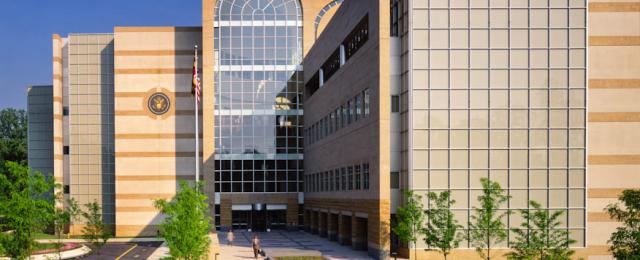
The United States District Court’s Greenbelt Division in southern Maryland is scheduled to get major renovations through a project valued between $20 million and $30 million. The project will be supported by federal funding that supports efforts using low embodied carbon materials and sustainable technologies. The project will include several key upgrades designed to reduce carbon emissions and enhance energy efficiency. The existing chillers will be replaced with high-performance models with lower global warming potential. Additionally, the project will involve retrofitting fluorescent lighting with energy-efficient LEDs and installing integrated lighting control systems. To further reduce the building’s carbon footprint, the heating system will be converted to air-source heat pumps, the HVAC control system will be modernized, and new cooling towers will be installed. These upgrades will enhance the building’s energy efficiency and contribute to a cleaner and healthier future for citizens. Design work is scheduled for 2025 and a contract for construction services will follow. The actual work will likely begin in 2026.
The William J. Nelson Federal Building, Courthouse, and Annex, located in Scranton, Pennsylvania, is also scheduled for a major renovation to modernize its heating, cooling and HVAC systems. The project will be designed to reduce emissions through technological innovations in sustainable construction. The effort will include replacing existing chillers with high-efficiency models with lower global warming potential. Also, gas-fired boilers will be replaced with heat pump technology, a more energy-efficient alternative. To further optimize the HVAC system, duct sealing, coil replacements in air handling units, and upgrades to the HVAC Controls will also be implemented. Existing fluorescent lights will be replaced with energy-efficient LEDs to reduce lighting energy consumption.
These upgrades are expected to significantly lower the building’s electricity usage, bringing it closer to net zero emissions. The project is currently in the planning phase, with solicitations for design and construction services anticipated to be issued in late 2025.
An upcoming renovation project at the Columbia Land Port of Entry Laredo, Texas is a key project under the General Services Administration’s Low-Carbon Materials Pilot Program and will be funded through the Inflation Reduction Act. With a budget of between $30-$40 million, the project will replace damaged pavement using low-embodied carbon materials, such as eco-friendly concrete and steel. By using low-carbon materials, the project will minimize the current environmental impact and improve the long-term durability of the port’s infrastructure. The project will include subsurface soil work and embankment repairs, enhancing resilience against climate extremes. Traffic flow enhancements will help reduce greenhouse gas emissions by improving traffic flow and allowing vehicles to avoid as much idle time. The overall objective will be to ensure that the Columbia Land Port of Entry is made more operationally efficient while supporting federal goals for a low-carbon and climate-resilient future. The design phase is expected to be completed by the end of 2024 and construction will begin in 2025.
The Thomasville FEMA Complex Regional Center in Georgia is due for a significant upgrade to improve its stormwater management systems. The project, supported by federal funding, will contribute to a more considerable federal effort to use low-carbon materials and meet sustainability goals. It will implement low-embodied carbon concrete to reduce the overall carbon footprint of the infrastructure, making it both environmentally friendly and resilient to climate-related challenges. The total budget for the project is estimated at $12 million, with half explicitly allocated for LEC materials and the remaining portion directed toward other high-performance green building practices. The stormwater management system upgrade will mitigate the impacts of climate change by managing excessive runoff during heavy rains, which has become a growing concern for federal infrastructure.
The design and pre-construction phases are expected to start in 2024, and the project is anticipated to move into full construction by 2025.
These projects are currently in planning and design phases throughout the U.S. Most are scheduled for contracting solicitations to be issued in early 2025. Contractors interested in the projects should be able to get more project details soon.